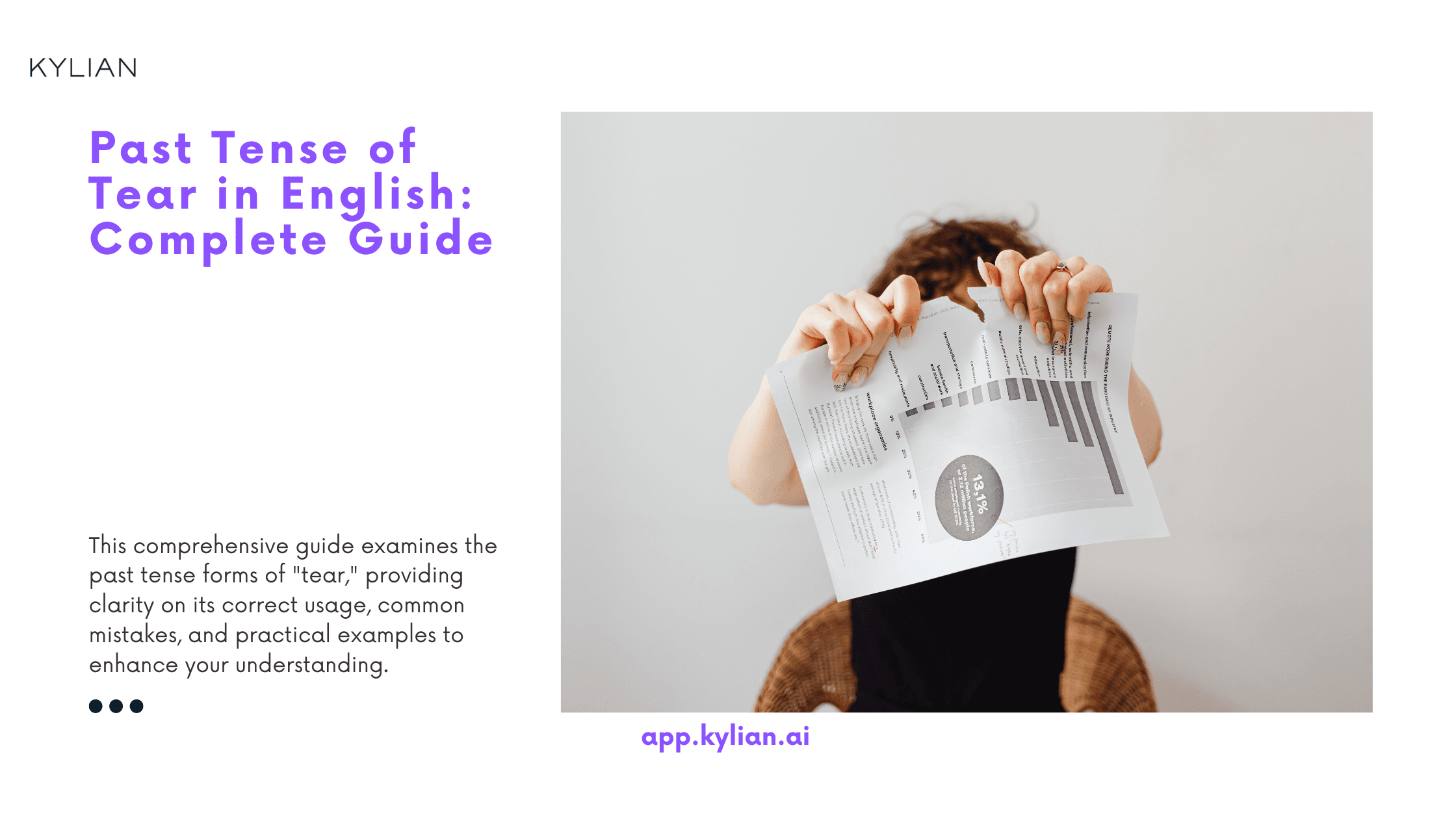
The English language presents numerous challenges for learners and native speakers alike, particularly when it comes to irregular verb forms. Among these, the verb "tear" stands out as a source of confusion due to its multiple meanings and forms. This comprehensive guide examines the past tense forms of "tear," providing clarity on its correct usage, common mistakes, and practical examples to enhance your understanding.
Understanding the Verb "Tear"
Before delving into past tense forms, we must first distinguish between two different verbs spelled as "tear" in English:
- To tear (pronounced /teər/): To rip or pull apart, creating a split or cut in something
- To tear (pronounced /tɪər/): To produce drops of liquid from the eyes due to emotion or irritation
These two homographs—words spelled identically but with different pronunciations and meanings—follow different conjugation patterns. This distinction forms the foundation of our analysis.
Past Tense of "Tear" (To Rip)
When "tear" refers to the action of ripping or pulling something apart, it follows an irregular conjugation pattern.
Simple Past Tense: Tore
The simple past tense of "tear" (to rip) is "tore."
Examples:
- She tore the envelope open excitedly when she received her acceptance letter.
- The hurricane tore through the coastal town, leaving significant destruction.
- He accidentally tore his new shirt while climbing over the fence.
- The protesters tore down the controversial statue during the demonstration.
The pronunciation of "tore" (/tɔːr/) differs significantly from the present tense "tear" (/teər/), which is a crucial distinction for learners to master.
Past Participle: Torn
The past participle form of "tear" (to rip) is "torn." This form is used with auxiliary verbs like "have," "had," or "has" to form perfect tenses.
Examples:
- I have torn my favorite book while lending it to a friend.
- By the time we arrived, they had already torn down the old building.
- He has torn through three pairs of shoes this year due to his intensive training.
- The document had been torn into pieces before anyone could read it.
The past participle "torn" is also commonly used as an adjective:
- Her jeans had a torn knee, which became an unintentional fashion statement.
- We found the torn remains of the letter in the fireplace.
- The torn ligament required immediate surgical intervention.
Past Tense of "Tear" (Related to Crying)
When "tear" refers to the action of producing tears from the eyes (crying), it follows a regular conjugation pattern.
Simple Past Tense: Teared
The simple past tense of "tear" (related to crying) is "teared."
Examples:
- His eyes teared up when he heard the emotional news.
- She teared up during the moving speech at the graduation ceremony.
- The actor teared up genuinely during the emotional scene, adding authenticity to the performance.
However, it's important to note that this usage is less common. In everyday English, phrases like "tears formed," "eyes watered," or "started to cry" are more frequently used than the verb form "teared."
Past Participle: Teared
The past participle form of "tear" (related to crying) is also "teared," following the regular pattern of adding "-ed" to the base form.
Examples:
- Her eyes have teared up several times during the sad movie.
- His eyes had teared up when he recalled the difficult memory.
Again, this form is less commonly used in everyday speech compared to alternative expressions.
Common Expressions with "Tear" in Past Tense
The verb "tear" appears in various idiomatic expressions, most of which use the meaning related to ripping rather than crying.
Tore Into
To criticize or attack verbally:
- The professor tore into the poorly prepared presentation without mercy.
- The critic tore into the new restaurant, criticizing everything from ambiance to food quality.
Tore Apart
- To completely disassemble:
- The mechanics tore apart the engine to identify the issue.
- Investigators tore apart the crime scene looking for evidence.
- To severely criticize:
- The review committee tore apart our initial proposal.
- The defense lawyer tore apart the prosecution's arguments.
- To cause emotional distress:
- The unexpected divorce tore apart their close-knit family.
- The scandal tore apart the previously united community.
Torn Between
To be unable to decide between two options:
- She was torn between accepting the job offer and pursuing further education.
- He was torn between loyalty to his friend and doing what he knew was right.
- The committee was torn between two equally qualified candidates.
Common Mistakes with the Past Tense of "Tear"
Understanding the correct past tense forms of "tear" helps avoid several common errors.
Confusion between "Tore" and "Teared"
The most frequent mistake involves using the wrong past tense form based on the intended meaning:
Incorrect: She teared the paper in half when she received the rejection letter. Correct: She tore the paper in half when she received the rejection letter.
Incorrect: His eyes tore up when he heard the sad news. Correct: His eyes teared up when he heard the sad news.
Mixing Past Simple and Past Participle Forms
Another common error is confusing "tore" (past simple) and "torn" (past participle):
Incorrect: I have tore my favorite shirt. Correct: I have torn my favorite shirt.
Incorrect: She had torn her dress yesterday during the party. Correct: She had tore her dress yesterday during the party.
Incorrect Pronunciation
The pronunciation differences between the various forms of "tear" can cause confusion:
- Present tense "tear" (to rip): /teər/
- Present tense "tear" (related to crying): /tɪər/
- Past tense "tore": /tɔːr/
- Past participle "torn": /tɔːrn/
- Past tense and past participle "teared": /tɪərd/
Mispronouncing these forms can lead to miscommunication, making proper pronunciation essential for effective communication.
Contextual Usage of "Tear" Past Tense Forms
Understanding when and how to use the past tense forms of "tear" requires attention to context and intended meaning.
In Narrative Writing
In storytelling and narrative writing, the past tense forms of "tear" add emotional weight and visual imagery:
"As she tore open the letter, her hands trembled. By the time she finished reading, her eyes had teared up, and the letter was nearly torn to pieces in her grip."
In Technical Descriptions
In technical or instructional contexts, precision in using the correct form is crucial:
"The technician tore away the protective covering and discovered that the internal wiring had been torn during shipping."
In Formal vs. Informal Speech
In formal contexts, the full forms are typically used, while in casual conversation, contractions are common:
Formal: "The document had been torn before submission." Informal: "The document'd been torn before they turned it in."
"Tear" vs. Other Irregular Verbs
Comparing "tear" with other irregular verbs helps establish patterns that aid in learning and retention.
Verbs Following Similar Patterns
Several English verbs follow conjugation patterns similar to "tear":
Several English verbs follow conjugation patterns similar to "tear":
- Tear → Tore → Torn
- Wear → Wore → Worn
- Bear → Bore → Born/Borne
- Swear → Swore → Sworn
Recognizing these patterns can help learners remember the correct forms.
Contrasting with Regular Verb Forms
Unlike irregular verbs like "tear," regular verbs follow predictable patterns, adding "-ed" or "-d" to form both the simple past and past participle:
Regular verb "walk":
- Base form: Walk
- Simple past: Walked
- Past participle: Walked
Irregular verb "tear":
- Base form: Tear
- Simple past: Tore
- Past participle: Torn
Etymology of "Tear" and Its Historical Forms
The historical development of "tear" provides insight into its irregular conjugation.
The verb "tear" (to rip) originates from the Old English "teran," which was already irregular in its past tense forms. This Old English verb descended from Proto-Germanic *teraną, explaining why similar irregular patterns appear in related Germanic languages.
Throughout Middle English, the verb maintained its irregularity, though spelling variations existed. By Early Modern English, the forms had largely stabilized to the "tear/tore/torn" pattern we recognize today.
This historical perspective explains why "tear" (to rip) retained its irregular conjugation while "tear" (related to crying)—which developed as a separate verb derived from the noun for the liquid produced by eyes—follows the regular pattern.
Tear in Different Verb Tenses
To gain a comprehensive understanding of "tear," let's examine its usage across all major tense forms.
Present Tense Forms
Simple Present:
- I/You/We/They tear the paper.
- He/She/It tears the paper.
Present Continuous:
- I am tearing the paper.
- He/She/It is tearing the paper.
- You/We/They are tearing the paper.
Present Perfect:
- I/You/We/They have torn the paper.
- He/She/It has torn the paper.
Present Perfect Continuous:
- I/You/We/They have been tearing paper all day.
- He/She/It has been tearing paper all day.
Past Tense Forms
Simple Past:
- I/You/He/She/It/We/They tore the paper.
Past Continuous:
- I/He/She/It was tearing the paper.
- You/We/They were tearing the paper.
Past Perfect:
- I/You/He/She/It/We/They had torn the paper.
Past Perfect Continuous:
- I/You/He/She/It/We/They had been tearing paper for hours.
Future Tense Forms
Simple Future:
- I/You/He/She/It/We/They will tear the paper.
Future Continuous:
- I/You/He/She/It/We/They will be tearing paper tomorrow.
Future Perfect:
- I/You/He/She/It/We/They will have torn all the paper by next week.
Future Perfect Continuous:
- I/You/He/She/It/We/They will have been tearing paper for two hours by the time you arrive.
Conditional Forms of "Tear"
Understanding conditional forms enhances versatility in using "tear" appropriately.
Zero Conditional:
- If people tear paper carelessly, it creates waste.
First Conditional:
- If you tear the document, you'll need to reprint it.
Second Conditional:
- If I tore my ticket, I wouldn't be able to attend the concert.
Third Conditional:
- If she had torn the contract, we would have had to draft a new one.
Mixed Conditional:
- If I hadn't torn my ACL last year, I would be competing in the tournament now.
Using "Tear" in Passive Voice
The passive voice construction with "tear" often emphasizes the recipient of the action rather than the agent.
Past Simple Passive
- The page was torn from the book.
- Their relationship was torn apart by constant disagreements.
Past Perfect Passive
- The document had been torn before it reached the intended recipient.
- By the time we arrived, the posters had been torn down.
Present Perfect Passive
- The ticket has been torn in half for validation.
- Several trees have been torn up by the storm.
Future Passive
- The old building will be torn down next month.
- These documents will have been torn up after the meeting.
Practical Applications and Examples
To solidify understanding, let's explore practical applications of "tear" in various contexts.
In Literature
"The wind tore at their clothes as they made their way across the desolate landscape. By nightfall, their garments had been torn to shreds, and their spirits had been torn between pressing on and turning back."
In Academic Writing
"Researchers tore apart previously accepted theories when new evidence emerged. The long-held hypothesis had been torn from its pedestal, creating an opportunity for fresh perspectives."
In Business Communication
"The legal team tore through the contract, identifying several concerning clauses. By the end of the review, the agreement had been torn apart and required significant revision."
In Everyday Conversation
"I tore my jacket climbing over that fence." "Have you torn the wrapping paper yet?" "Her eyes teared up during the emotional reunion."
Using "Tear" in Different English Dialects
The usage and sometimes even conjugation of "tear" can vary slightly across English dialects.
American English
American English strictly follows the tear/tore/torn pattern for the "to rip" meaning. For the crying-related meaning, American English speakers typically use phrases like "eyes welled up" or "became teary" more frequently than the verb "teared up," though the latter is still recognized.
British English
British English follows the same conjugation patterns as American English but may feature slight pronunciation differences, particularly in the vowel sounds.
Australian and New Zealand English
These variants generally align with British English in terms of conjugation and usage patterns.
Regional Variations
In some regional dialects, particularly in casual speech, you might occasionally hear non-standard forms like "teared" instead of "tore" for the ripping meaning, but these are considered grammatically incorrect in standard English.
Memory Techniques for Learning Irregular Verb Forms
Mastering irregular verbs like "tear" can be challenging. Here are effective strategies for remembering the correct forms:
Pattern Recognition
Group "tear" with other verbs following the same pattern:
- Tear → Tore → Torn
- Wear → Wore → Worn
- Bear → Bore → Born/Borne
- Swear → Swore → Sworn
Learning these as a group makes it easier to remember the pattern.
Mnemonic Devices
Create memorable phrases containing the three forms: "I tear paper today, I tore paper yesterday, and I have torn paper before."
Contextual Learning
Practice using "tear" in meaningful sentences rather than isolated conjugation exercises. This approach embeds the correct forms in practical usage contexts.
Visual Associations
Associate the verb forms with visual images:
- Tear → A whole piece of paper
- Tore → The action of ripping
- Torn → The resulting ripped state
Advanced Grammar: "Tear" in Subjunctive Mood
The subjunctive mood expresses hypothetical or non-factual situations, wishes, demands, or suggestions.
"If I tore this contract now, what would the consequences be?" "The professor demanded that no student tear pages from the reference books." "I wish he hadn't torn up the letter before reading it completely."
Understanding how to use "tear" in the subjunctive mood adds sophistication to your English usage.
Learn Any Language with Kylian AI
Private language lessons are expensive. Paying between 15 and 50 euros per lesson isn’t realistic for most people—especially when dozens of sessions are needed to see real progress.
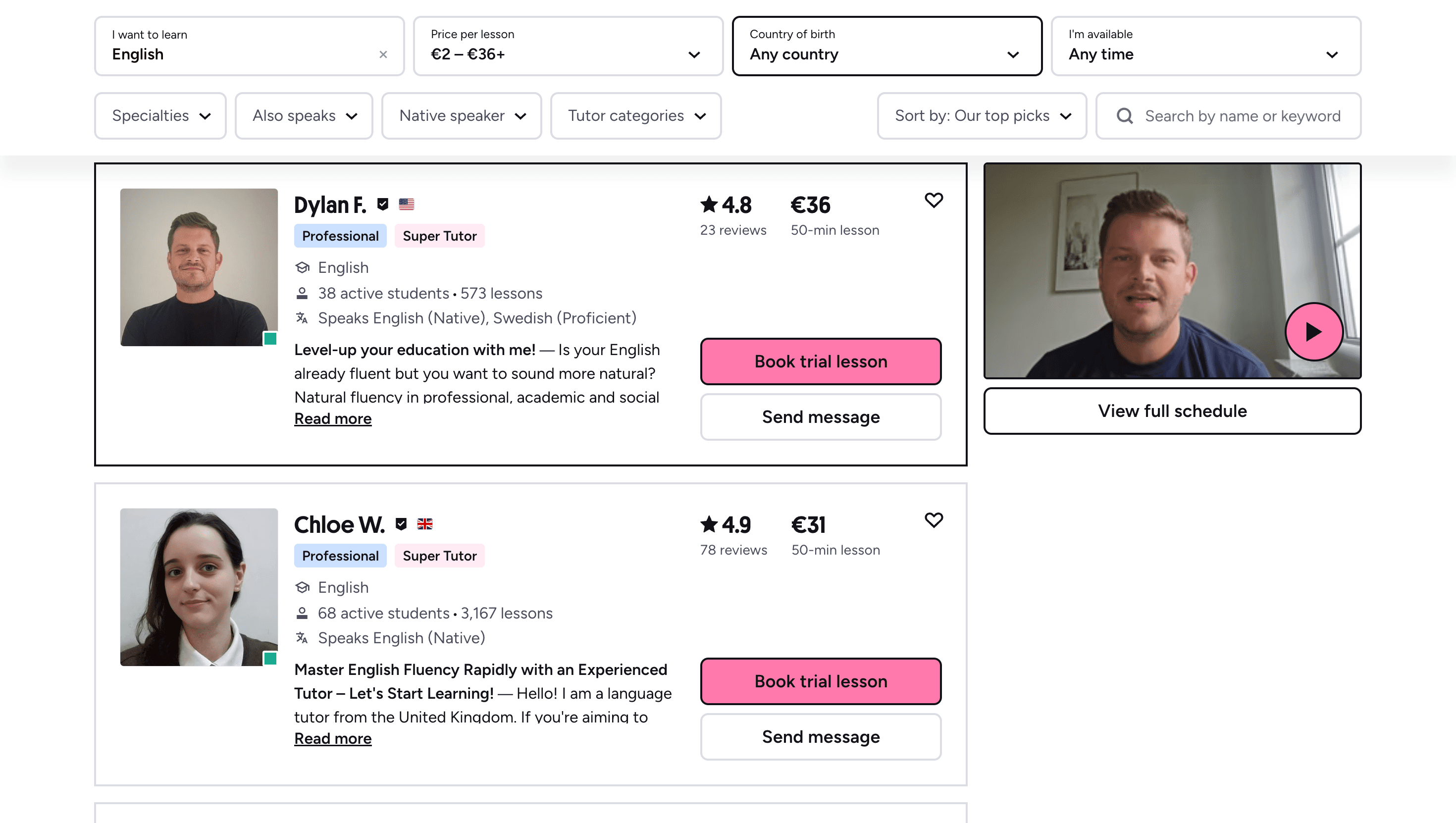
Many learners give up on language learning due to these high costs, missing out on valuable professional and personal opportunities.
That’s why we created Kylian: to make language learning accessible to everyone and help people master a foreign language without breaking the bank.
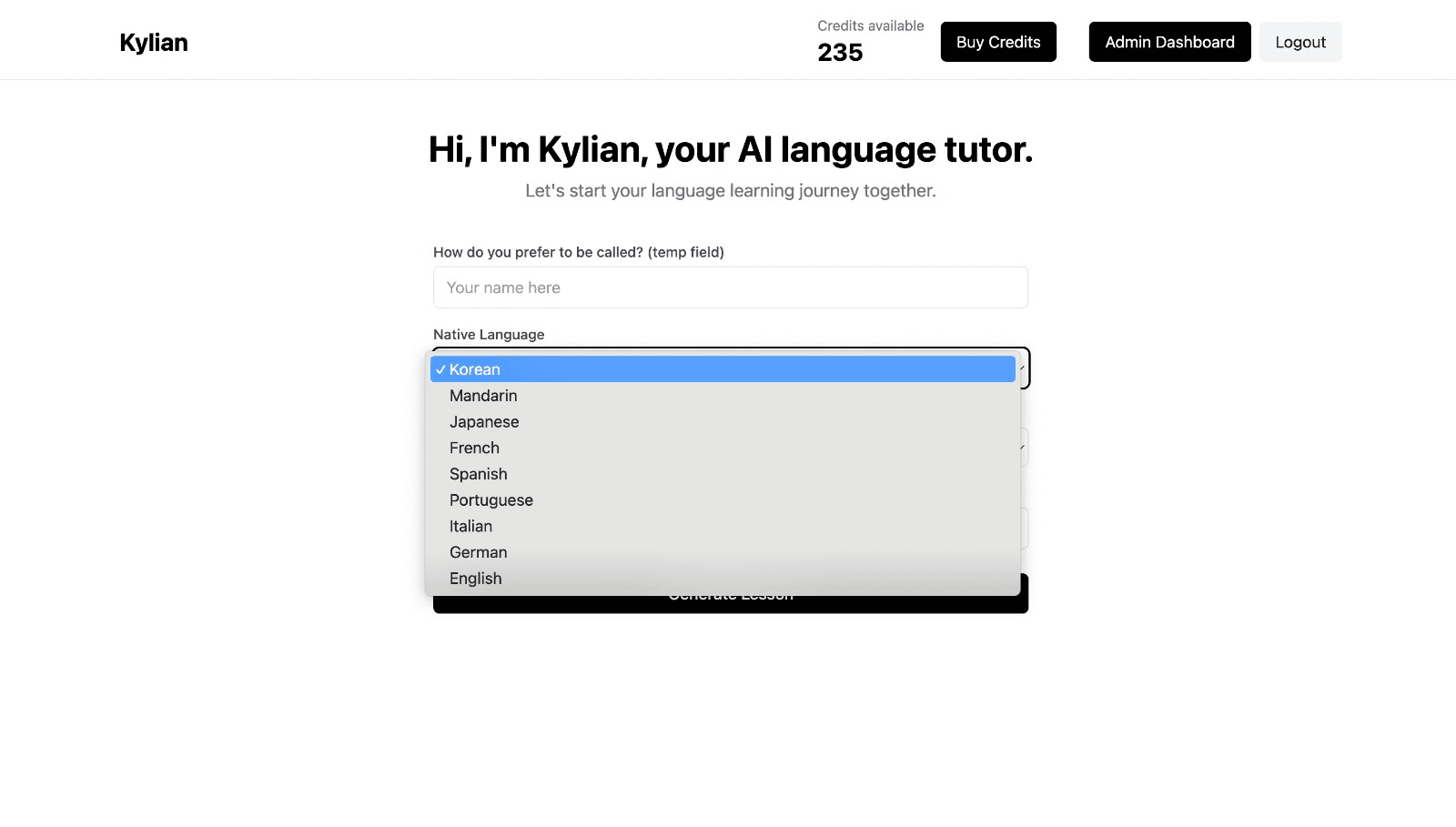
To get started, just tell Kylian which language you want to learn and what your native language is
Tired of teachers who don’t understand your specific struggles as a French speaker? Kylian’s advantage lies in its ability to teach any language using your native tongue as the foundation.
Unlike generic apps that offer the same content to everyone, Kylian explains concepts in your native language (French) and switches to the target language when necessary—perfectly adapting to your level and needs.
This personalization removes the frustration and confusion that are so common in traditional language learning.
Choose a specific topic you want to learn
Frustrated by language lessons that never cover exactly what you need? Kylian can teach you any aspect of a language—from pronunciation to advanced grammar—by focusing on your specific goals.
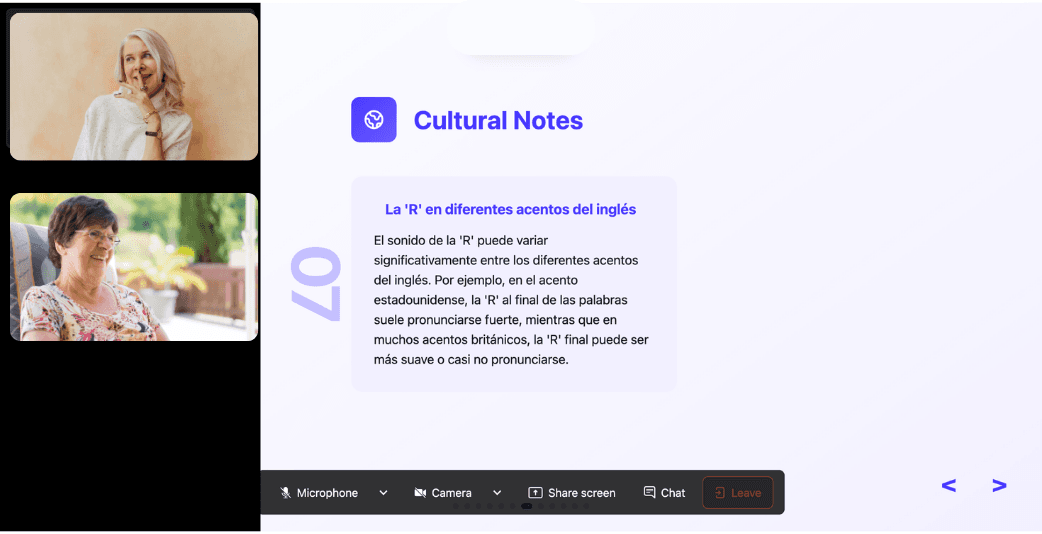
Avoid vague requests like “How can I improve my accent?” and be precise: “How do I pronounce the R like a native English speaker?” or “How do I conjugate the verb ‘to be’ in the present tense?”
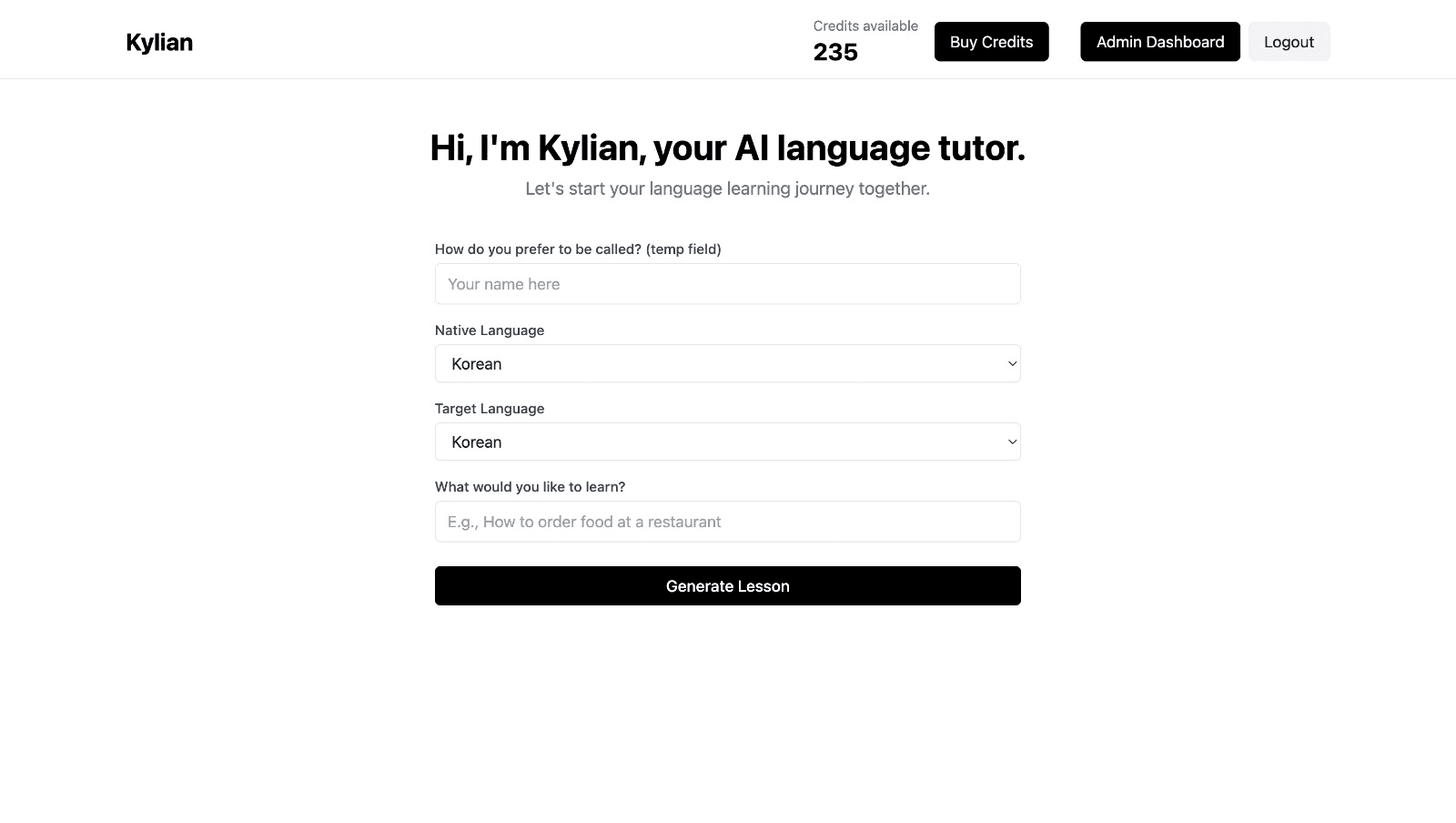
With Kylian, you’ll never again pay for irrelevant content or feel embarrassed asking “too basic” questions to a teacher. Your learning plan is entirely personalized.
Once you’ve chosen your topic, just hit the “Generate a Lesson” button, and within seconds, you’ll get a lesson designed exclusively for you.
Join the room to begin your lesson
The session feels like a one-on-one language class with a human tutor—but without the high price or time constraints.

In a 25-minute lesson, Kylian teaches exactly what you need to know about your chosen topic: the nuances that textbooks never explain, key cultural differences between French and your target language, grammar rules, and much more.

Ever felt frustrated trying to keep up with a native-speaking teacher, or embarrassed to ask for something to be repeated? With Kylian, that problem disappears. It switches intelligently between French and the target language depending on your level, helping you understand every concept at your own pace.
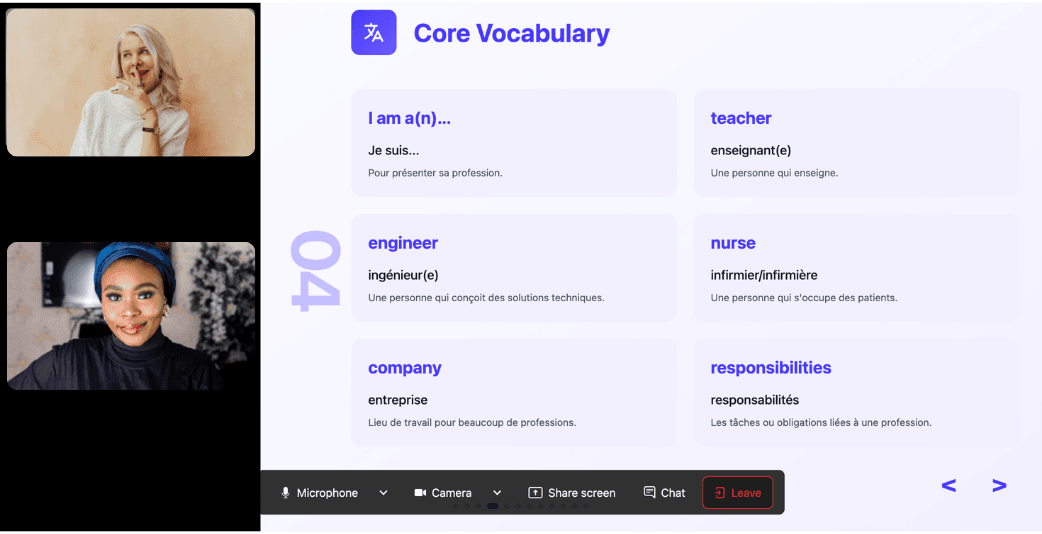
During the lesson, Kylian uses role-plays, real-life examples, and adapts to your learning style. Didn’t understand something? No problem—you can pause Kylian anytime to ask for clarification, without fear of being judged.

Ask all the questions you want, repeat sections if needed, and customize your learning experience in ways traditional teachers and generic apps simply can’t match.

With 24/7 access at a fraction of the cost of private lessons, Kylian removes all the barriers that have kept you from mastering the language you’ve always wanted to learn.