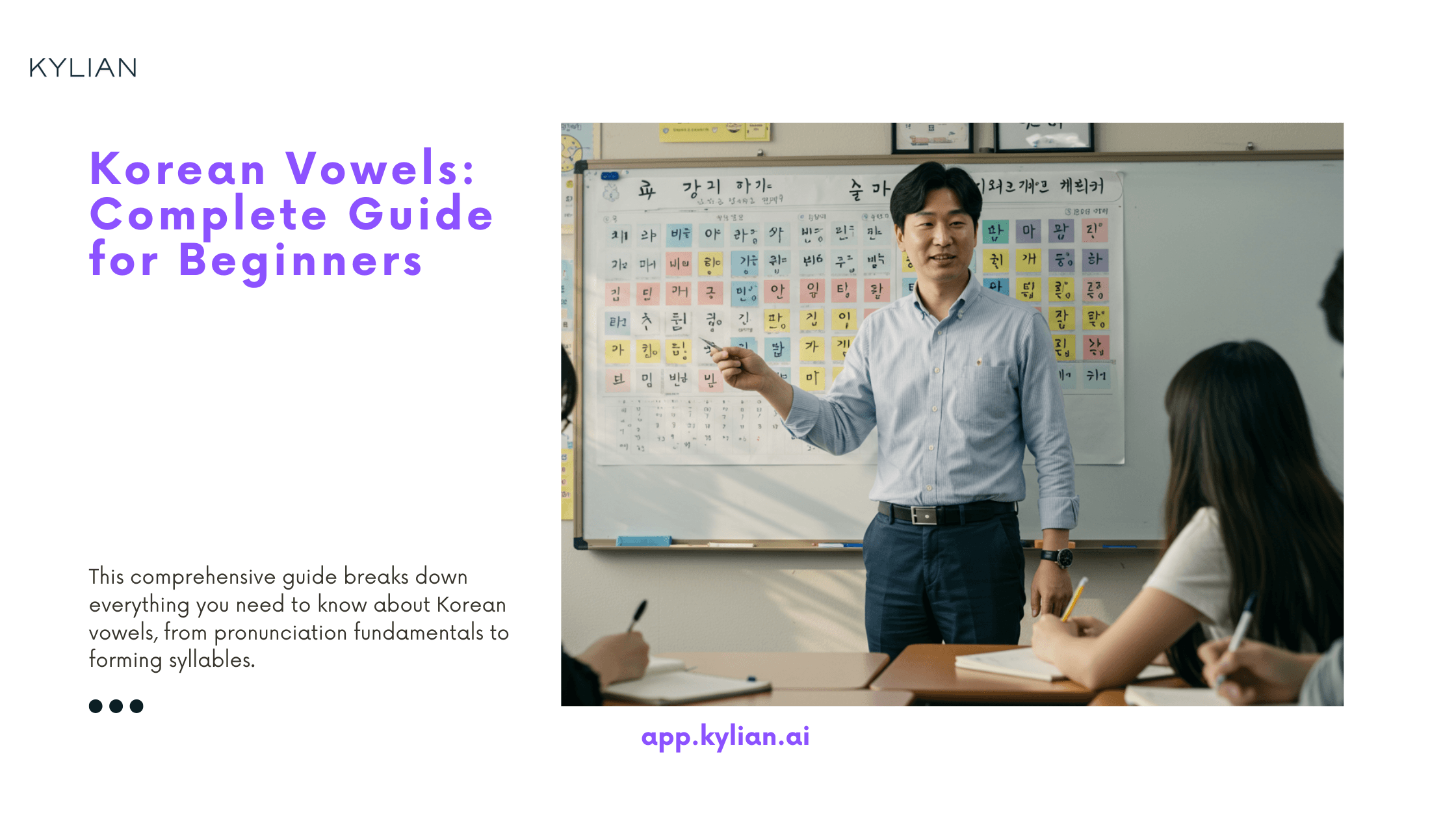
Learning a new writing system can be intimidating, especially one as different from the Latin alphabet as Hangul, the Korean writing system. However, understanding Korean vowels—the foundation of Hangul—provides a strategic entry point that makes the entire learning process more manageable. This comprehensive guide breaks down everything you need to know about Korean vowels, from pronunciation fundamentals to forming syllables.
Understanding the Korean Alphabet (Hangul) Structure
Hangul's systematic design makes it remarkably learner-friendly compared to other Asian writing systems. Created in the 15th century by King Sejong the Great, Hangul was specifically designed to be accessible to all Korean citizens, regardless of social class or education level.
At its core, Hangul consists of two types of characters:
- Consonants (자음 - jaeum)
- Vowels (모음 - moeum)
What makes Korean particularly accessible is that, unlike English with its many pronunciation exceptions, Korean vowels maintain consistent sounds. This predictability significantly accelerates the learning curve for beginners.
Korean Basic Vowels
Korean features 10 basic vowels, each with a distinct shape and sound. Notably, these vowels don't have unique names like consonants do—they're simply referred to by the sounds they make.
Here's a breakdown of these fundamental vowels:
- ㅏ (a) - Pronounced like the 'a' in "father"
- ㅑ (ya) - Pronounced like "ya" in "yard"
- ㅓ (eo) - Similar to the 'u' in "butter" (with no 'r' sound)
- ㅕ (yeo) - Like "yo" in "yogurt" but with an 'e' sound instead of 'o'
- ㅗ (o) - Similar to the 'o' in "hope"
- ㅛ (yo) - Pronounced like "yo" in "yo-yo"
- ㅜ (u) - Similar to "oo" in "food"
- ㅠ (yu) - Pronounced like "yu" in "university"
- ㅡ (eu) - No direct English equivalent; position your lips as if saying "ee" but make an "uh" sound
- ㅣ (i) - Pronounced like "ee" in "meet"
Understanding these basic vowels is crucial because they form the building blocks for all Korean vowel sounds. Once you've mastered these ten, you'll have the foundation needed to tackle the more complex combinations.
Distinguishing Vertical and Horizontal Vowels
Korean vowels can be categorized based on their orientation:
Vertical Vowels:
- ㅏ (a), ㅑ (ya), ㅓ (eo), ㅕ (yeo), ㅣ (i)
- These vowels appear to the right of the consonant in a syllable
Horizontal Vowels:
- ㅗ (o), ㅛ (yo), ㅜ (u), ㅠ (yu), ㅡ (eu)
- These vowels appear below the consonant in a syllable
This orientation becomes important when forming syllables, as it determines how characters are arranged within the syllable block.
Korean Double Vowels (Compound Vowels)
Double vowels, also called compound vowels, are formed by combining two basic vowels. Rather than creating a new sound entirely, these combinations typically blend the component vowel sounds together.
Here are the 11 Korean double vowels:
- ㅐ (ae) - Similar to 'e' in "egg"
- ㅒ (yae) - Similar to "ye" in "yes" with a slight 'a' sound
- ㅔ (e) - Similar to 'e' in "red"
- ㅖ (ye) - Sounds like "ye" in "yes"
- ㅘ (wa) - Pronounced like "wa" in "water"
- ㅙ (wae) - Similar to "way" in English
- ㅚ (oe) - Similar to the French "eu" sound or "way" in modern Korean
- ㅝ (wo) - Pronounced like "wo" in "won"
- ㅞ (we) - Similar to "we" in "wet"
- ㅟ (wi) - Pronounced like "we" in "week"
- ㅢ (ui/eui) - A unique sound; pronounce "eu" followed quickly by "i"
How Korean Double Vowels Are Formed
Understanding the pattern of how double vowels are created helps with memorization:
- ㅐ (ae) = ㅏ (a) + ㅣ (i)
- ㅒ (yae) = ㅑ (ya) + ㅣ (i)
- ㅔ (e) = ㅓ (eo) + ㅣ (i)
- ㅖ (ye) = ㅕ (yeo) + ㅣ (i)
- ㅘ (wa) = ㅗ (o) + ㅏ (a)
- ㅙ (wae) = ㅗ (o) + ㅐ (ae)
- ㅚ (oe) = ㅗ (o) + ㅣ (i)
- ㅝ (wo) = ㅜ (u) + ㅓ (eo)
- ㅞ (we) = ㅜ (u) + ㅔ (e)
- ㅟ (wi) = ㅜ (u) + ㅣ (i)
- ㅢ (ui/eui) = ㅡ (eu) + ㅣ (i)
What makes this pattern particularly valuable for learners is that it allows you to deduce the pronunciation of complex vowels by understanding their component parts.
Pronunciation Challenges and Solutions
While Korean vowels generally maintain consistent pronunciation, certain vowels present unique challenges for English speakers. Addressing these specific difficulties accelerates proficiency.
The "ㅡ" (eu) Challenge
The vowel ㅡ (eu) has no direct English equivalent, making it particularly challenging for beginners. To produce this sound:
- Position your mouth as if preparing to say "ee" (as in "see")
- Flatten your tongue against the bottom of your mouth
- Without rounding your lips, make an "uh" sound
Practice by repeating Korean words containing this vowel, such as 음식 (eumsik - food) or 즐겁다 (jeulgeobda - to be happy).
Distinguishing Similar Vowel Sounds
Modern Korean pronunciation has evolved such that certain vowel pairs now sound nearly identical, especially in casual speech:
- ㅔ (e) and ㅐ (ae) often sound the same in contemporary spoken Korean
- ㅙ (wae), ㅚ (oe), and ㅞ (we) are increasingly pronounced identically by younger Korean speakers
Even native Korean speakers sometimes struggle to distinguish these sounds, so don't be discouraged if you find them challenging. Focus instead on context and spelling when learning vocabulary.
The Multi-Pronunciation ㅢ (ui/eui)
The compound vowel ㅢ (ui/eui) presents a special case, as its pronunciation varies depending on its position within a word:
- When it appears at the beginning of a word or independently, it's pronounced as "eui" (의사 - uisa - doctor)
- In the final position of a word after a consonant, it's often simplified to "i" (회의 - hoeui - meeting, often pronounced "hoei")
- When it follows another vowel, it's frequently pronounced as "e" (그의 - geuui - his/hers, often pronounced "geu-e")
This flexibility underscores the importance of listening to native speakers rather than relying solely on textbook pronunciations.
Syllable Formation with Korean Vowels
Understanding how vowels function within Korean syllables is essential for proper reading and writing. Every Korean syllable follows specific structural rules:
- Basic requirement: Every syllable must contain at least one consonant and one vowel
- Vowel-initial words: Even syllables that seem to begin with a vowel actually start with the silent consonant ㅇ
- Syllable block arrangement: The position of vowels within the syllable block depends on whether they're vertical, horizontal, or a combination
Syllable Structure Examples:
- 가 (ga): Consonant ㄱ (g) + vertical vowel ㅏ (a)
- 모 (mo): Consonant ㅁ (m) + horizontal vowel ㅗ (o)
- 괴 (goe): Consonant ㄱ (g) + combination vowel ㅚ (oe)
- 의 (ui): Silent consonant ㅇ + combination vowel ㅢ (ui)
The visual arrangement of these components creates the distinct square-like appearance of Korean text. This systematic approach to syllable formation makes Korean writing more predictable once you've learned the basic rules.
How Korean Vowels Differ from English Vowels
Several fundamental differences between Korean and English vowel systems explain why English speakers might struggle with Korean pronunciation:
- Consistency: Korean vowels maintain consistent sounds across different words, unlike English vowels that can vary significantly (compare the 'a' in "father," "apple," and "always")
- Length: While some Korean dialects historically distinguished between long and short vowel sounds, standard modern Korean generally doesn't rely on vowel length to differentiate meaning
- Diphthongs vs. Compound Vowels: English diphthongs involve a smooth transition between two vowel sounds within a single syllable (like the 'oi' in "coin"). Korean compound vowels technically combine two vowels but are pronounced as single, unified sounds
- Vowel harmony: Traditional Korean featured vowel harmony (where certain vowels could only appear with compatible vowels in the same word), though this feature has largely disappeared from modern Korean
Understanding these differences provides context for why certain aspects of Korean pronunciation may feel counterintuitive to English speakers.
The Evolving Pronunciation of Korean Vowels
Modern Korean pronunciation continues to evolve, with several notable trends affecting vowel sounds:
- Regional variations: Vowel pronunciation varies across different regions of Korea, with Seoul dialect generally considered the standard
- Generational differences: Younger speakers increasingly merge vowel sounds that older Koreans might still distinguish
- Historical changes: Some vowel sounds that were distinct in mid-20th century Korean have merged in contemporary speech
For language learners, these ongoing changes mean that flexibility in pronunciation and exposure to a variety of speakers become valuable aspects of the learning process.
Common Pronunciation Mistakes and How to Avoid Them
Awareness of typical pronunciation pitfalls helps beginners avoid developing problematic habits:
- Over-diphthongization: English speakers tend to add glides to vowels, changing a pure Korean ㅗ (o) into something closer to "ou." Maintain steady, pure vowel sounds without the sliding transitions common in English.
- Incorrect mouth positioning: Korean vowels require specific mouth shapes. For example, ㅜ (u) needs more rounded lips than many English speakers naturally use.
- Ignoring the silent ㅇ: Remember that when ㅇ appears at the beginning of a syllable, it's silent but still functions as a consonant placeholder.
- Applying English stress patterns: Korean doesn't emphasize syllables through volume or pitch in the same way English does. Maintain even stress across syllables.
Regularly recording and comparing your pronunciation with native speakers can help identify and correct these common issues.
Practical Approach to Learning Korean Vowels
Rather than attempting to memorize every vowel in isolation, consider these practical learning strategies:
- Start with high-frequency vowels: Focus first on mastering ㅏ (a), ㅓ (eo), ㅗ (o), ㅜ (u), and ㅣ (i), which appear most frequently in Korean vocabulary
- Learn vowels in meaningful contexts: Practice vowels within common Korean words rather than in isolation. For example, learn 나 (na - I/me), 너 (neo - you), 오늘 (oneul - today)
- Group vowels by sound relationships: Study related vowels together (like ㅏ/ㅑ and ㅓ/ㅕ pairs) to understand the patterns
- Use consonant-vowel combinations: Practice syllables like 가, 나, 다 (ga, na, da) to understand how vowels connect with consonants
- Utilize vowel-focused tongue twisters: Korean tongue twisters that emphasize specific vowels provide engaging pronunciation practice
These approaches integrate vowel learning into practical language use rather than treating it as an isolated academic exercise.
Leveraging Technology for Vowel Mastery
Modern language learners have access to technological tools that can accelerate vowel acquisition:
- Pronunciation analysis apps: Applications like "Korean Pronunciation" provide real-time feedback on vowel accuracy
- Spaced repetition systems: Digital flashcard systems can prioritize difficult vowels based on your performance
- Slow-motion audio: Tools that allow slowing down native speech help identify subtle vowel distinctions
- Interactive syllable builders: Digital tools that let you construct and hear syllables reinforce the relationship between written vowels and their sounds
These technological approaches provide immediate feedback that wasn't available to language learners even a decade ago.
Beyond Basic Vowels: Advanced Pronunciation Features
As your Korean proficiency grows, several advanced vowel-related features become important:
Vowel Contraction in Natural Speech
In conversational Korean, adjacent vowels from different syllables often contract, creating sounds that don't appear in the standard vowel inventory:
- 해요 (haeyo - informal polite "do") can sound closer to "haeyo" when spoken quickly
- 뭐 해? (mwo hae? - "What are you doing?") often contracts to sound like "mwae?"
Vowel Length in Regional Dialects
While standard Seoul Korean has largely lost vowel length distinctions, some regional dialects (particularly in North Korea and parts of South Korea's Gyeongsang Province) maintain meaningful vowel length differences:
- 말 (mal) with a short vowel means "horse"
- 말 (maal) with a long vowel means "speech" or "language"
Understanding these regional variations enriches your comprehension, especially when interacting with Koreans from different regions.
Learn Any Language with Kylian AI
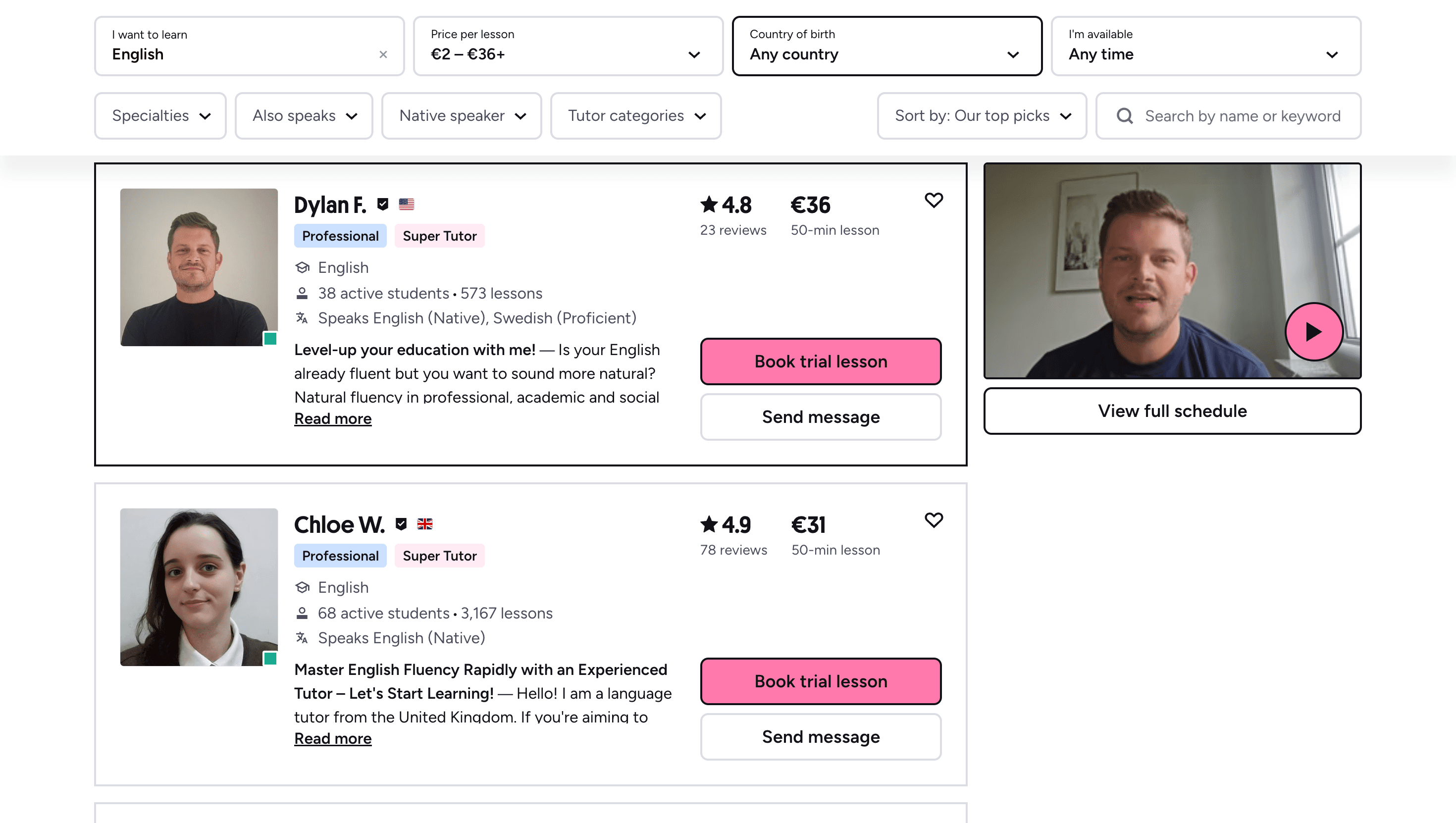
Private language lessons are expensive. Paying between 15 and 50 euros per lesson isn’t realistic for most people—especially when dozens of sessions are needed to see real progress.
Many learners give up on language learning due to these high costs, missing out on valuable professional and personal opportunities.
That’s why we created Kylian: to make language learning accessible to everyone and help people master a foreign language without breaking the bank.
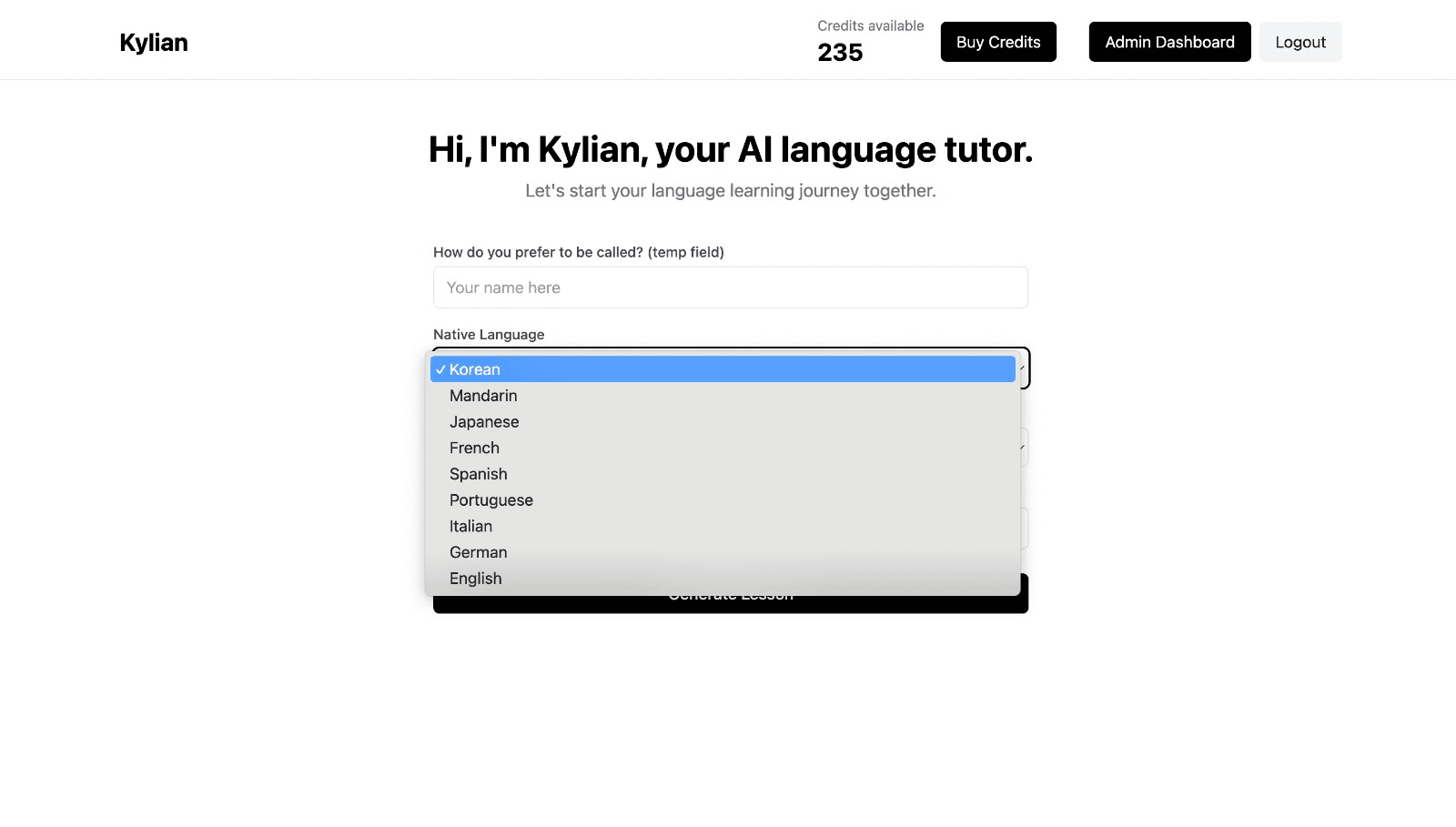
To get started, just tell Kylian which language you want to learn and what your native language is
Tired of teachers who don’t understand your specific struggles as a French speaker? Kylian’s advantage lies in its ability to teach any language using your native tongue as the foundation.
Unlike generic apps that offer the same content to everyone, Kylian explains concepts in your native language (French) and switches to the target language when necessary—perfectly adapting to your level and needs.
This personalization removes the frustration and confusion that are so common in traditional language learning.
Choose a specific topic you want to learn
Frustrated by language lessons that never cover exactly what you need? Kylian can teach you any aspect of a language—from pronunciation to advanced grammar—by focusing on your specific goals.
Avoid vague requests like “How can I improve my accent?” and be precise: “How do I pronounce the R like a native English speaker?” or “How do I conjugate the verb ‘to be’ in the present tense?”
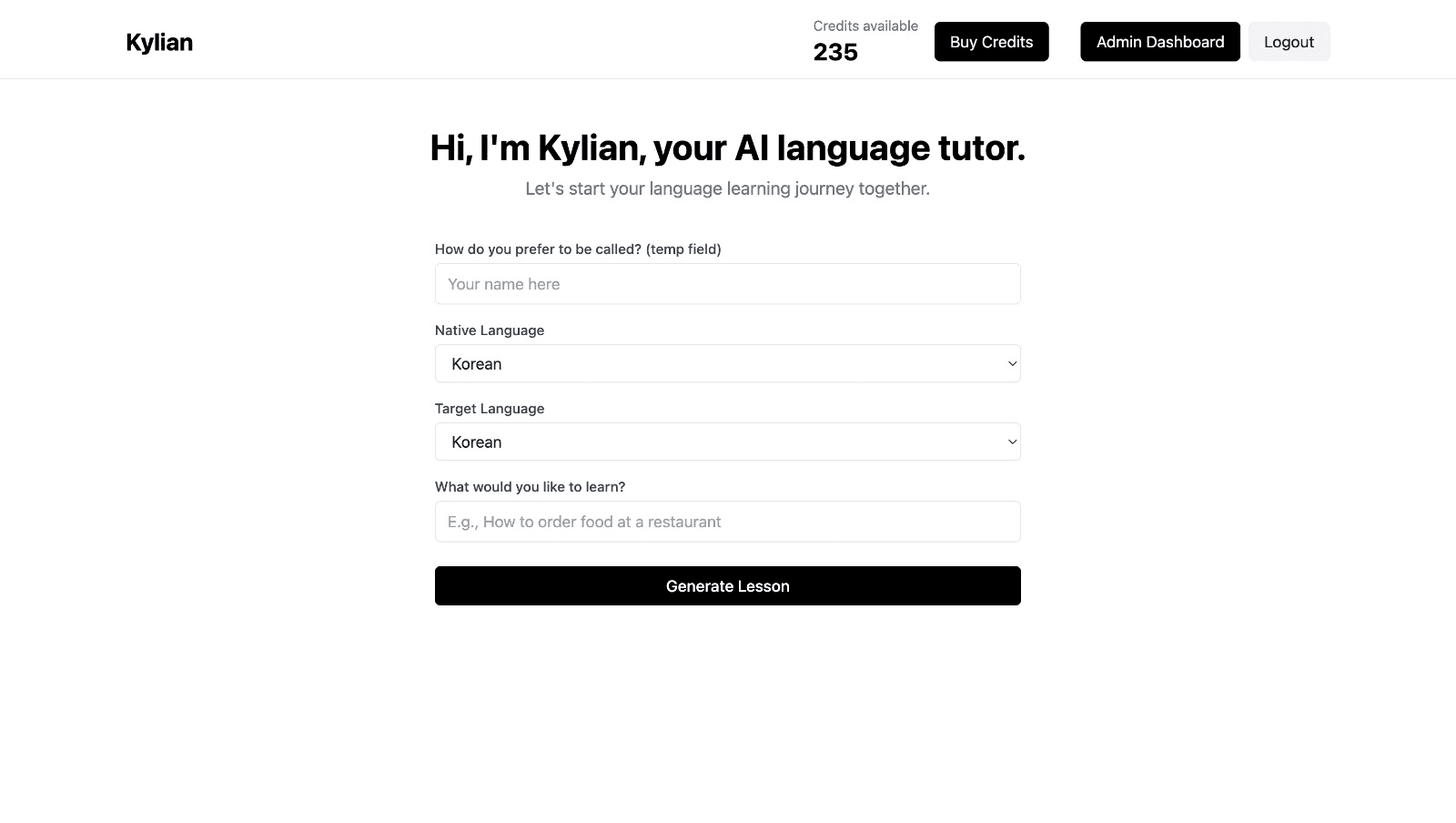
With Kylian, you’ll never again pay for irrelevant content or feel embarrassed asking “too basic” questions to a teacher. Your learning plan is entirely personalized.
Once you’ve chosen your topic, just hit the “Generate a Lesson” button, and within seconds, you’ll get a lesson designed exclusively for you.
Join the room to begin your lesson
The session feels like a one-on-one language class with a human tutor—but without the high price or time constraints.
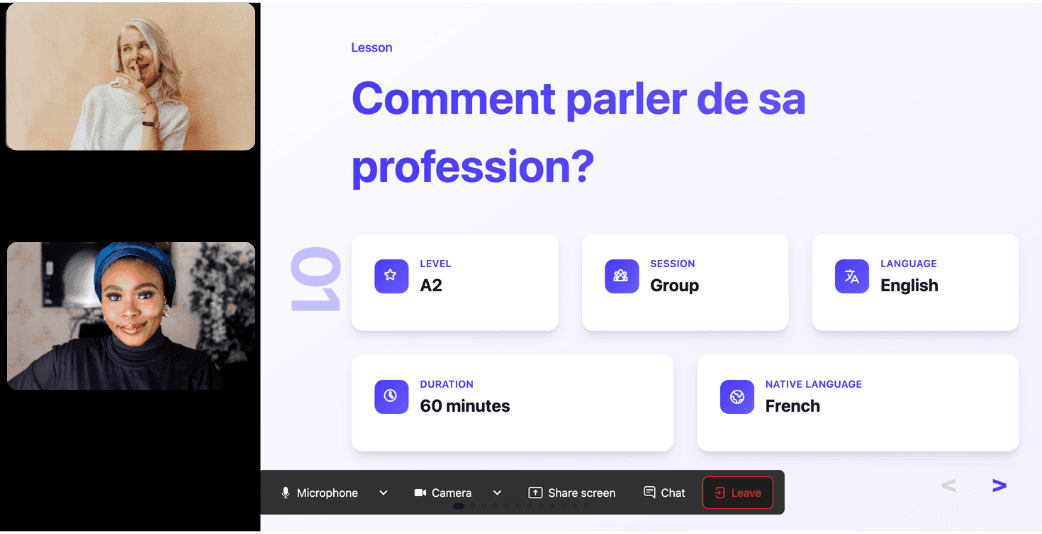
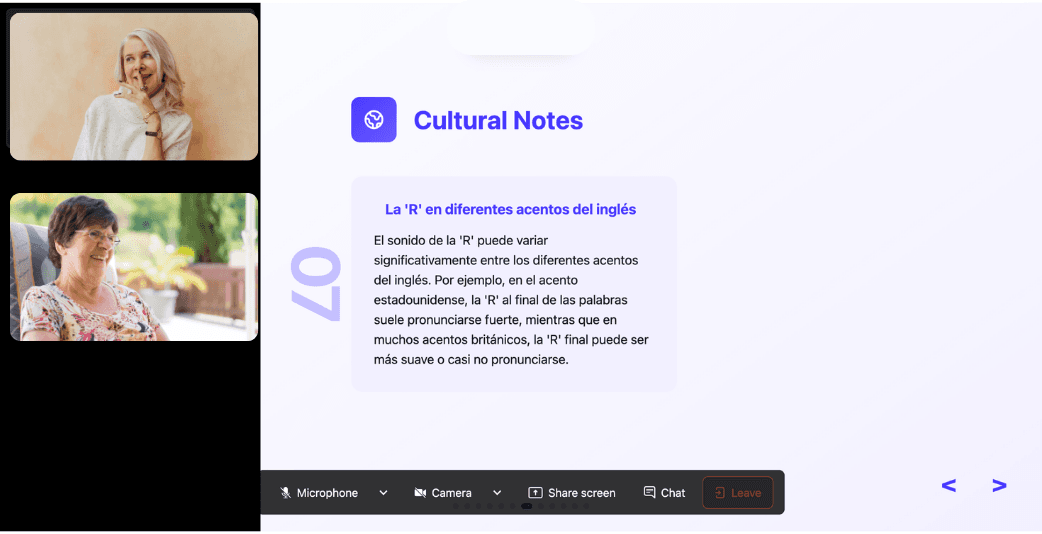
In a 25-minute lesson, Kylian teaches exactly what you need to know about your chosen topic: the nuances that textbooks never explain, key cultural differences between French and your target language, grammar rules, and much more.
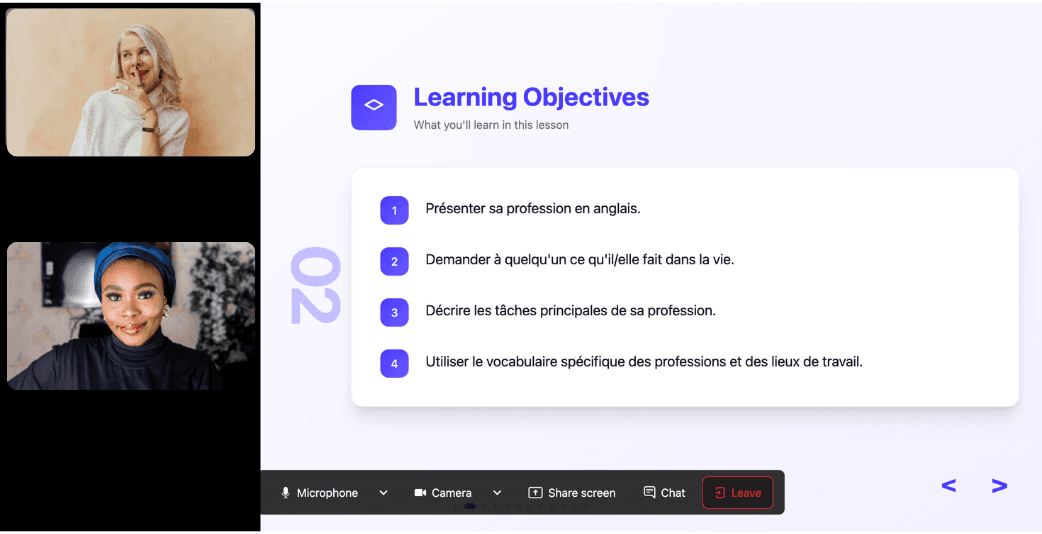
Ever felt frustrated trying to keep up with a native-speaking teacher, or embarrassed to ask for something to be repeated? With Kylian, that problem disappears. It switches intelligently between French and the target language depending on your level, helping you understand every concept at your own pace.
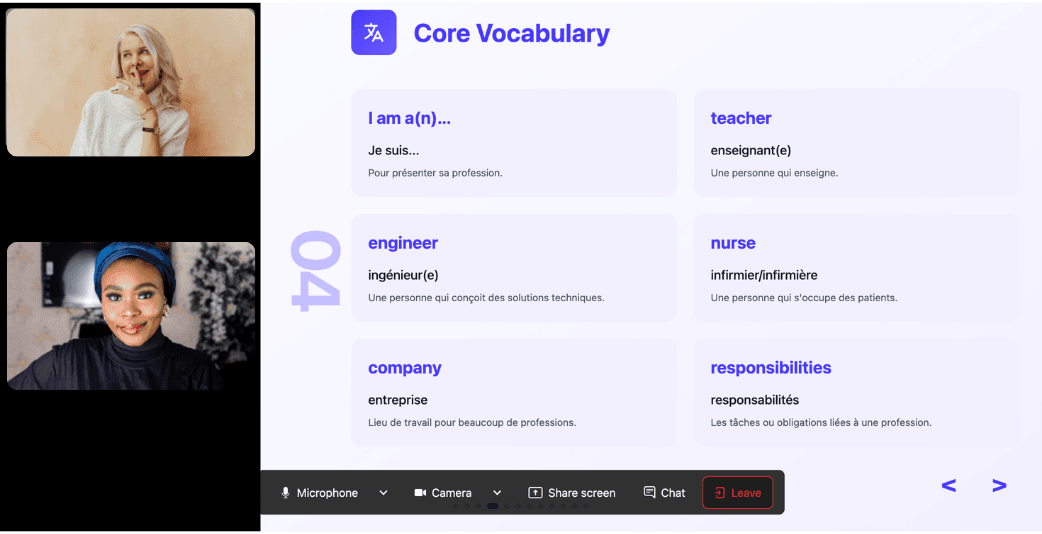
During the lesson, Kylian uses role-plays, real-life examples, and adapts to your learning style. Didn’t understand something? No problem—you can pause Kylian anytime to ask for clarification, without fear of being judged.
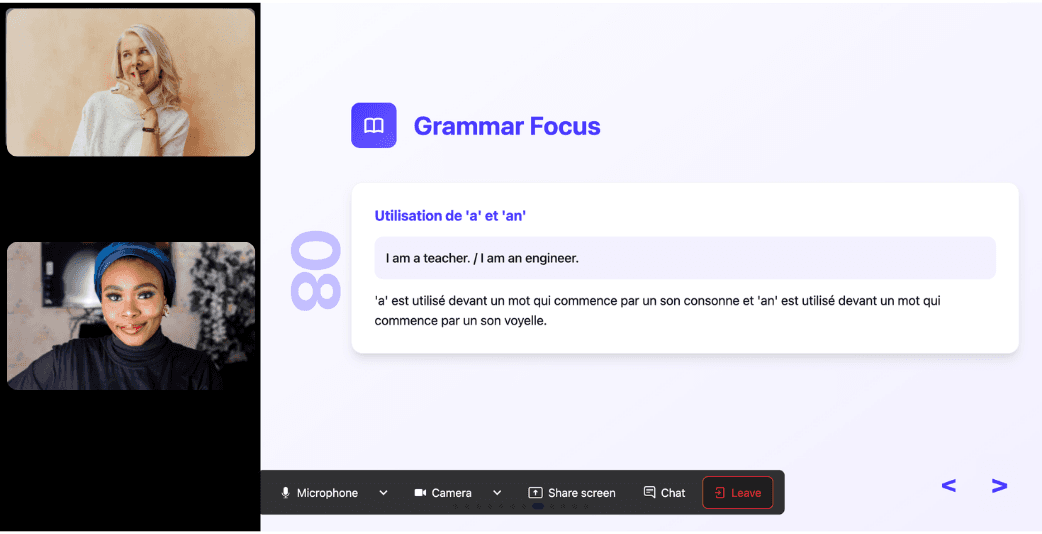
Ask all the questions you want, repeat sections if needed, and customize your learning experience in ways traditional teachers and generic apps simply can’t match.
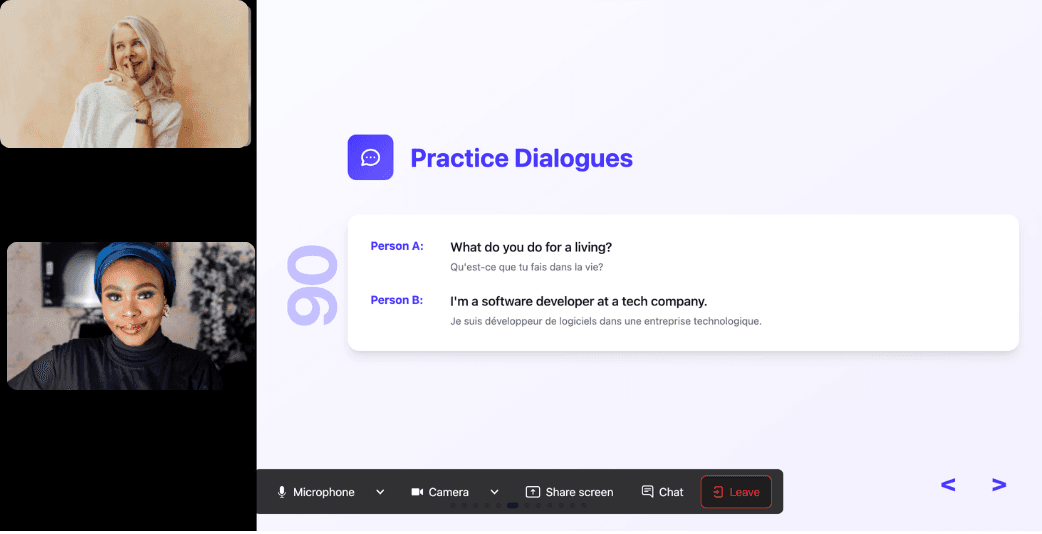
With 24/7 access at a fraction of the cost of private lessons, Kylian removes all the barriers that have kept you from mastering the language you’ve always wanted to learn.