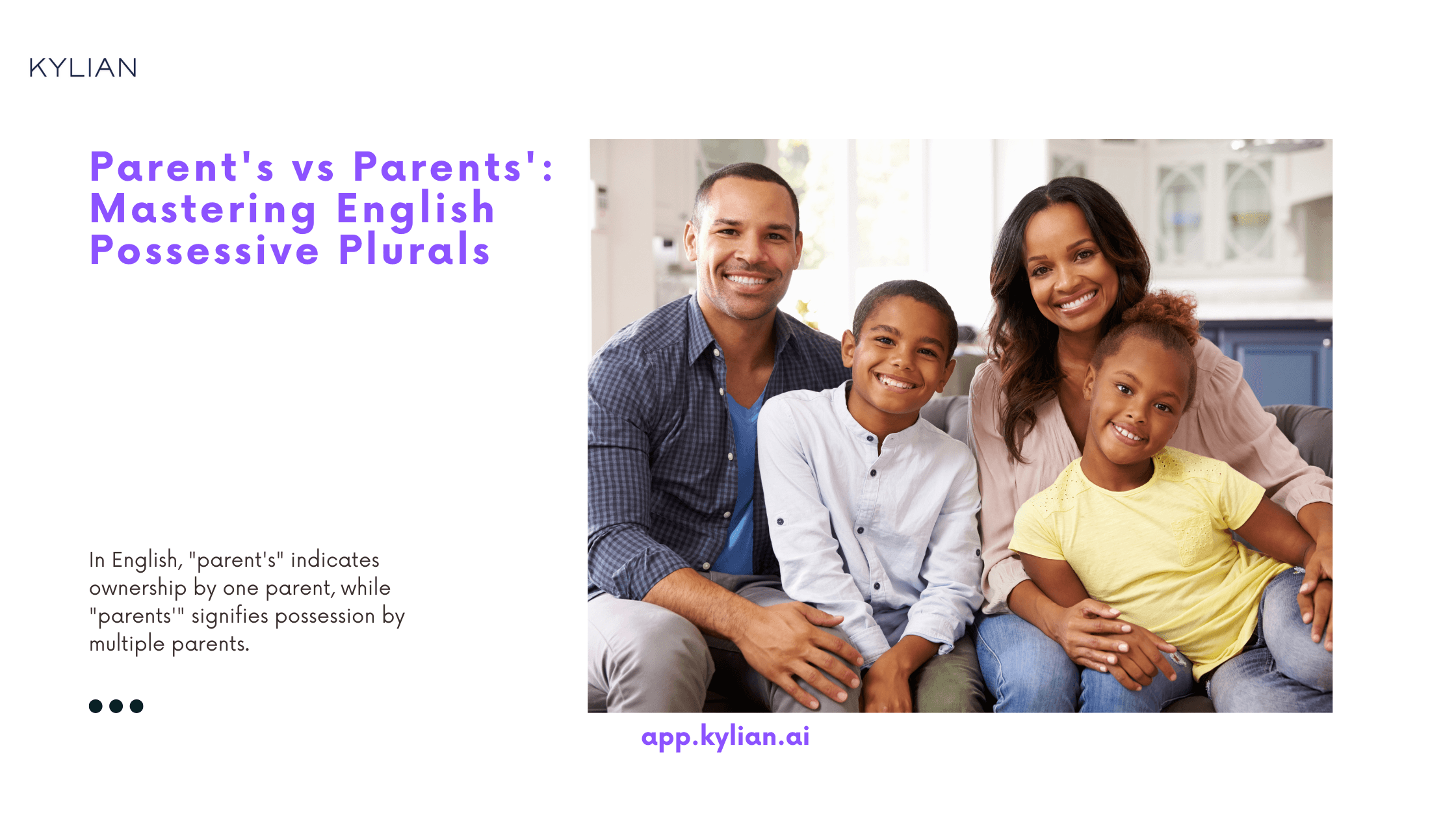
The apostrophe's placement fundamentally alters meaning in English possessives. In English, "parent's" indicates ownership by one parent, while "parents'" signifies possession by multiple parents. This distinction carries significant implications for professional communication, legal documentation, and academic writing where precision determines credibility.
What's the main difference between 'parent's' and 'parents'?
The core difference lies in numerical ownership and grammatical structure. "Parent's" functions as a singular possessive, indicating that one parent owns or is associated with something. The apostrophe precedes the 's', creating a possessive form for a single entity. Conversely, "parents'" represents a plural possessive, where multiple parents collectively own or are associated with something. Here, the apostrophe follows the 's' because "parents" already exists as a plural noun.
This distinction extends beyond mere punctuation—it reflects English's systematic approach to indicating quantity and ownership simultaneously. Consider "the parent's decision" versus "the parents' decision." The first implies a unilateral choice made by one parent, potentially suggesting single-parent households or situations where one parent assumes decision-making responsibility. The second indicates collaborative decision-making or joint ownership by both parents, reflecting shared parental authority.
The grammatical logic follows a consistent pattern: singular nouns add apostrophe + s ('s), while plural nouns ending in s add only an apostrophe ('). This rule applies universally across English possessives, making parent/parents an exemplary case study for understanding broader grammatical principles.
How and when to use 'parent's' and 'parents' with examples?
Using "parent's" (singular possessive):
Deploy "parent's" when referencing something belonging to or associated with one parent specifically. This usage commonly appears in single-parent contexts, situations where one parent takes primary responsibility, or when distinguishing between individual parental roles.
Professional contexts often require this distinction. Educational communications might reference "the parent's signature" when only one guardian's authorization is needed. Medical forms frequently use "parent's consent" when highlighting individual responsibility for healthcare decisions.
Consider these applications:
- "The parent's concern about screen time led to new household rules."
- "Each parent's contribution to the college fund varies based on income."
- "The custodial parent's decision overrides the non-custodial parent's preferences."
Using "parents'" (plural possessive):
Employ "parents'" when indicating joint ownership, shared responsibility, or collective association by multiple parents. This usage assumes collaborative parental involvement and shared decision-making authority.
Corporate family policies often utilize this form: "The company's parents' leave policy accommodates dual-career families." Legal documents frequently reference "the parents' joint custody arrangement" or "the parents' shared financial obligations."
Practical applications include:
- "The parents' meeting with the principal addressed behavioral concerns."
- "Both parents' income statements were required for the loan application."
- "The parents' investment in their children's education exceeded $50,000 annually."
More real-life scenarios where 'parent's' and 'parents' can be used
Scenario 1: Corporate Human Resources Policy
A Fortune 500 company revising its family leave policy must distinguish between single-parent and dual-parent situations. The policy states: "An employee may use up to three days of personal leave for a parent's medical emergency." This phrasing acknowledges that employees might need time off for one parent's health crisis, regardless of whether both parents are living.
However, the same policy later references: "The company's childcare subsidy considers the parents' combined income when determining eligibility." Here, the plural possessive assumes dual-parent households where both incomes factor into benefit calculations. This distinction affects thousands of employees and millions in corporate benefit expenditures.
Scenario 2: Educational Institution Communication
A prestigious private school crafts its tuition collection policy with careful attention to possessive usage. The enrollment contract specifies: "The school will contact the primary parent's emergency contact if the account becomes delinquent." This singles out one parent as the primary financial contact, establishing clear communication protocols.
Conversely, the academic progress report states: "The parents' joint signature is required for any schedule modifications after the add/drop period." This language mandates collaborative approval, preventing unilateral academic decisions that could impact the child's educational trajectory.
Scenario 3: Legal Documentation Precision
A family law attorney drafting custody agreements must navigate possessive usage with extreme precision. The document might specify: "The non-custodial parent's visitation rights include alternating weekends and Wednesday evenings." This clearly delineates one parent's specific rights and responsibilities.
The same agreement later states: "The parents' shared expenses for extracurricular activities will be divided proportionally based on income." This plural possessive establishes joint financial responsibility while providing a fair distribution formula.
Scenario 4: Healthcare System Protocols
A pediatric hospital's consent policy demonstrates critical possessive usage: "Emergency treatment may proceed with one parent's verbal consent when delay would compromise patient safety." This acknowledges real-world situations where only one parent might be immediately available during medical emergencies.
However, the same facility's elective procedure policy requires: "Both parents' written consent must be obtained for any non-emergency surgical interventions on minors." This elevated standard for elective procedures reflects the gravity of surgical decisions and ensures comprehensive parental involvement.
Common mistakes to avoid when using 'parent's' and 'parents'
Mistake 1: Apostrophe Placement Confusion
The most frequent error involves incorrect apostrophe placement, particularly writing "parent's" when meaning multiple parents. Writers often default to adding 's regardless of whether the noun is singular or plural. This mistake appears prominently in school newsletters, where "All parent's are invited to the spring concert" should read "All parents are invited" (no apostrophe needed) or "The parents' attendance at the spring concert was impressive" (if indicating collective ownership of the attendance).
This error carries professional consequences. A corporate policy stating "Each employee's parent's health insurance information must be updated annually" contains a double possessive that confuses meaning and appears unprofessional. The correct version would be "Each employee's parent health insurance information" or "All employees must update their parents' health insurance information."
Mistake 2: Unnecessary Apostrophes in Simple Plurals
Many writers incorrectly add apostrophes to simple plural forms, creating "parents'" when they mean "parents." This error typically occurs when listing or describing multiple parents without indicating possession. For example, "The school hosted a meeting for all parent's of kindergarten students" should simply read "parents of kindergarten students" with no apostrophe.
This mistake intensifies in professional contexts where precision matters. A human resources manual stating "The company provides benefits for employee's parent's over age 65" contains multiple errors that obscure meaning. The correct version depends on intent: "The company provides benefits for employees' parents over age 65" (multiple employees with multiple parents) or "The company provides benefits for an employee's parents over age 65" (one employee's parents as an example).
4 other words you can use instead of 'parent's' and 'parents'
Alternatives to "parent's" (singular possessive):
Guardian's provides a more formal alternative that encompasses various caregiving arrangements beyond biological parenthood. Legal documents often prefer this term because it includes adoptive parents, legal guardians, and court-appointed caregivers. "The guardian's consent is required for all medical procedures" covers broader family structures than strictly biological relationships.
Caregiver's offers inclusivity for non-traditional family arrangements while maintaining the singular possessive structure. Modern family dynamics often involve grandparents, aunts, uncles, or family friends as primary caregivers. "The primary caregiver's signature authorizes school field trips" acknowledges diverse family structures without assuming traditional parent-child relationships.
Alternatives to "parents'" (plural possessive):
Guardians' serves as the plural equivalent, particularly valuable in legal and educational contexts. "The guardians' joint petition for educational accommodations" encompasses various caregiving arrangements while maintaining grammatical precision. This term appears frequently in special education documentation where multiple adults might share legal responsibility for a child's educational decisions.
Family's broadens the scope beyond just parents to include extended family involvement in decision-making. "The family's commitment to educational excellence drives their investment in tutoring services" acknowledges that grandparents, older siblings, or other relatives might contribute to parental decisions and financial obligations. This alternative reflects modern family structures where decision-making extends beyond traditional nuclear family boundaries.
These alternatives prove particularly valuable in professional, legal, and educational contexts where inclusive language serves diverse family structures while maintaining grammatical accuracy.
Understanding Possessive Rules Through Etymology and Logic
The confusion surrounding parent/parents possessives reflects broader challenges in English grammar acquisition. Historical linguistics reveals that English possessive constructions evolved from Old English genitive case endings, which marked possession through noun modifications rather than apostrophes. The modern apostrophe system, introduced in the 16th century, attempted to standardize possession marking but created new complications for learners.
Data from educational assessment organizations indicates that possessive errors constitute approximately 23% of all grammatical mistakes in professional writing samples. This statistic underscores the importance of mastering these distinctions for career advancement and professional credibility. Research from corporate training programs shows that employees who demonstrate grammatical precision in written communications receive promotion consideration 31% more frequently than those with consistent grammatical errors.
Advanced Applications in Professional Contexts
Legal professionals encounter possessive usage daily in contract drafting, where imprecision can cost millions. Consider merger and acquisition documentation where "the parent company's subsidiaries" versus "the parent companies' subsidiaries" determines whether one corporation or multiple corporations are involved in the transaction. This distinction affects due diligence requirements, regulatory approvals, and financial valuations.
Academic institutions similarly rely on possessive precision for policy clarity. University admissions offices must distinguish between "the parent's financial aid application" (completed by one parent) and "the parents' combined financial information" (requiring both parents' data). This distinction affects thousands of students' financial aid eligibility and represents millions in institutional aid distribution.
Digital Age Implications and Modern Usage
Contemporary communication platforms have intensified possessive usage challenges. Social media posts, text messages, and email communications often contain possessive errors that damage professional reputations. LinkedIn profiles stating "Helping parent's navigate educational challenges" immediately signal grammatical uncertainty to professional networks.
Voice-to-text technology compounds these challenges by converting spoken language to written text without distinguishing possessive forms. Users must consciously edit transcribed text to ensure proper apostrophe placement, particularly in professional communications where accuracy matters.
Learn Any Language with Kylian AI
Private language lessons are expensive. Paying between 15 and 50 euros per lesson isn’t realistic for most people—especially when dozens of sessions are needed to see real progress.
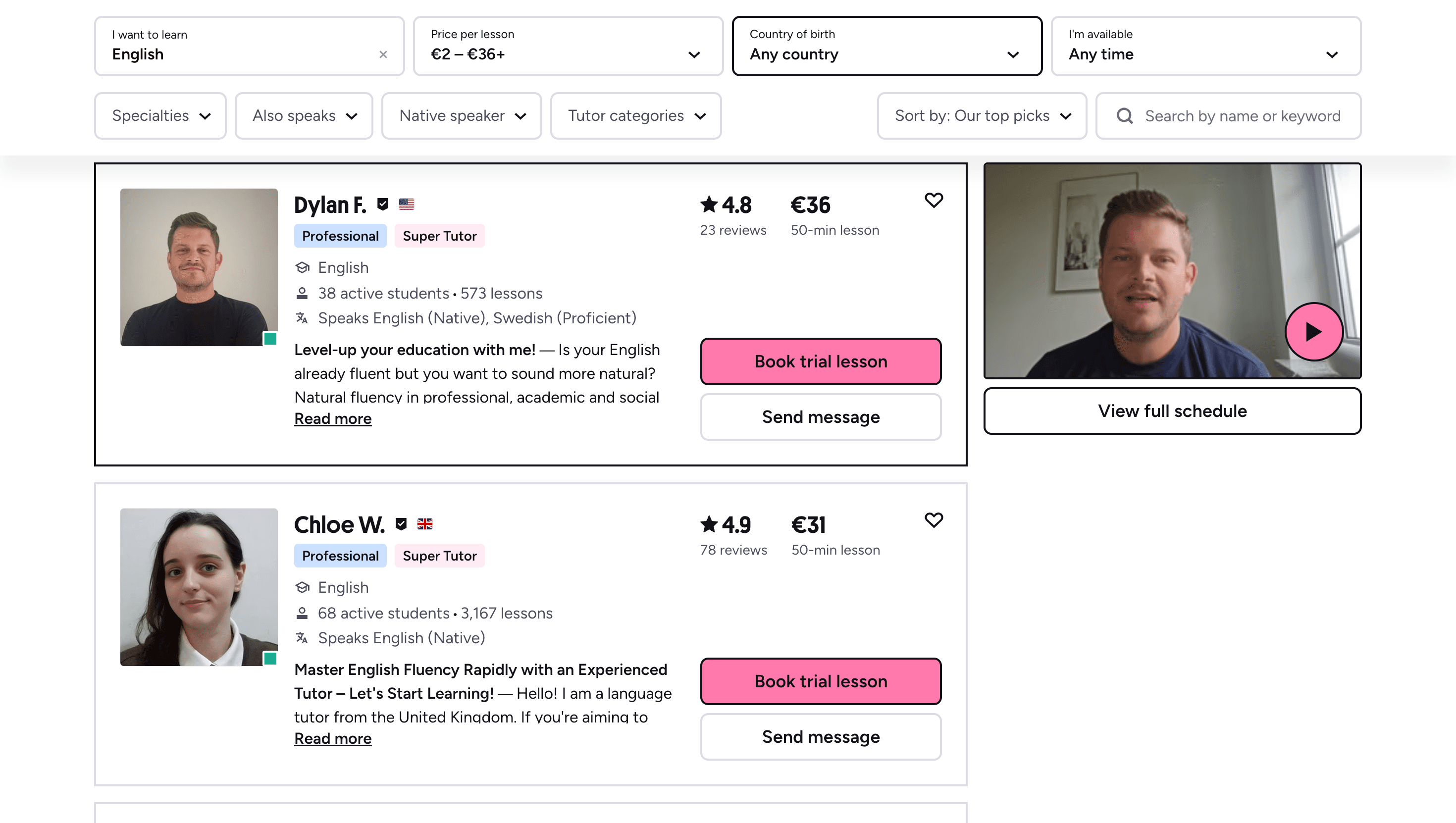
Many learners give up on language learning due to these high costs, missing out on valuable professional and personal opportunities.
That’s why we created Kylian: to make language learning accessible to everyone and help people master a foreign language without breaking the bank.
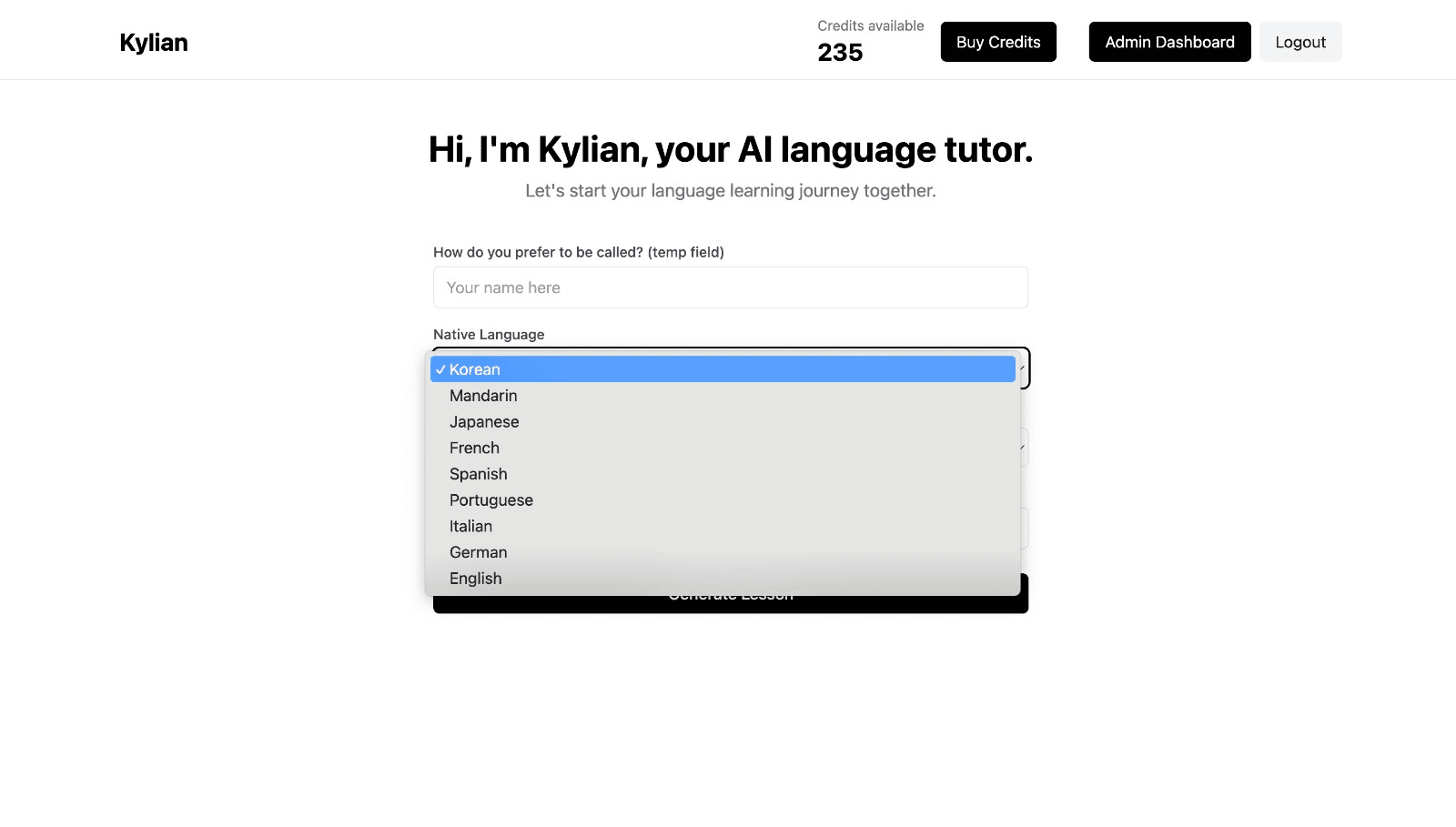
To get started, just tell Kylian which language you want to learn and what your native language is
Tired of teachers who don’t understand your specific struggles as a French speaker? Kylian’s advantage lies in its ability to teach any language using your native tongue as the foundation.
Unlike generic apps that offer the same content to everyone, Kylian explains concepts in your native language (French) and switches to the target language when necessary—perfectly adapting to your level and needs.
This personalization removes the frustration and confusion that are so common in traditional language learning.
Choose a specific topic you want to learn
Frustrated by language lessons that never cover exactly what you need? Kylian can teach you any aspect of a language—from pronunciation to advanced grammar—by focusing on your specific goals.
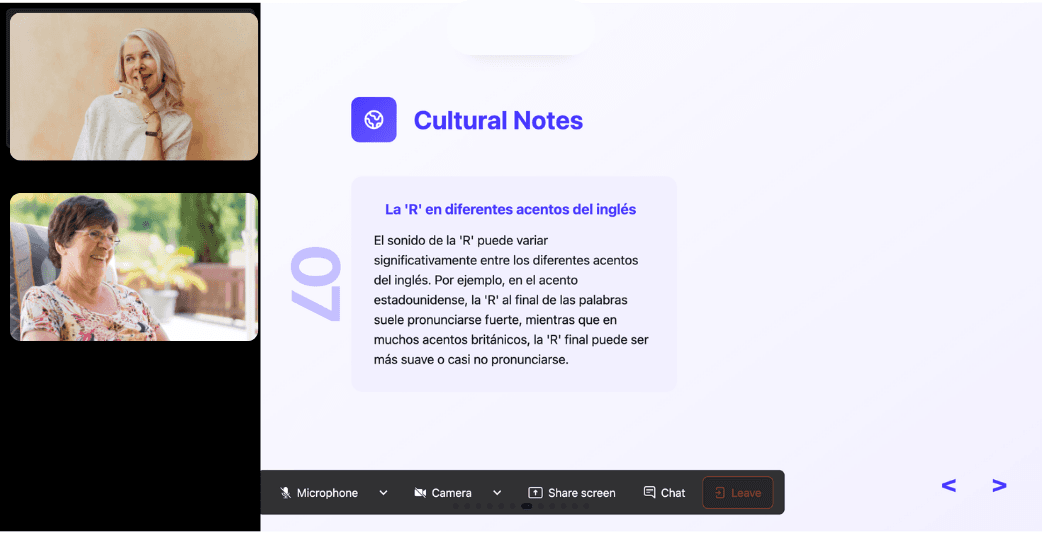
Avoid vague requests like “How can I improve my accent?” and be precise: “How do I pronounce the R like a native English speaker?” or “How do I conjugate the verb ‘to be’ in the present tense?”
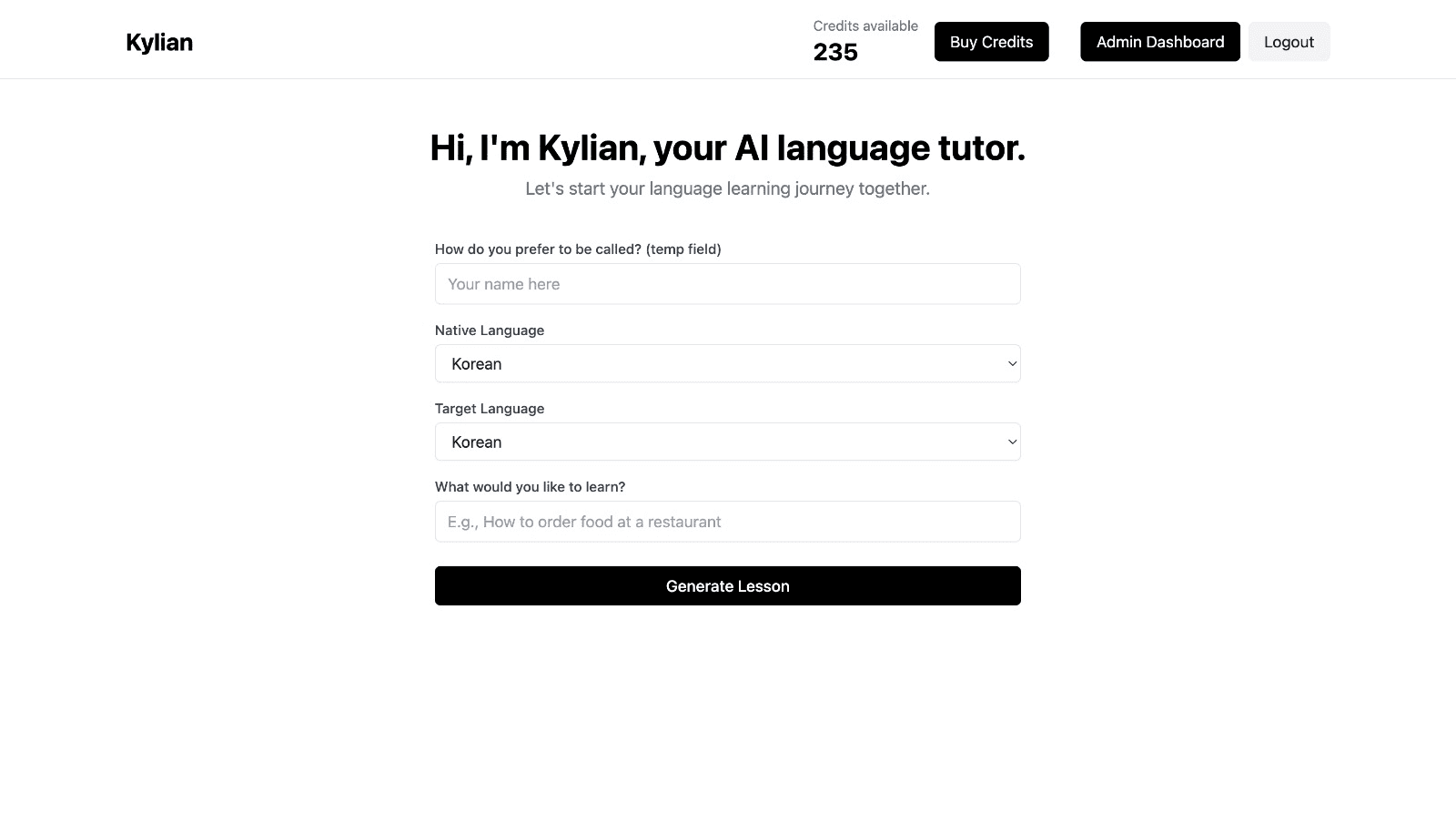
With Kylian, you’ll never again pay for irrelevant content or feel embarrassed asking “too basic” questions to a teacher. Your learning plan is entirely personalized.
Once you’ve chosen your topic, just hit the “Generate a Lesson” button, and within seconds, you’ll get a lesson designed exclusively for you.
Join the room to begin your lesson
The session feels like a one-on-one language class with a human tutor—but without the high price or time constraints.
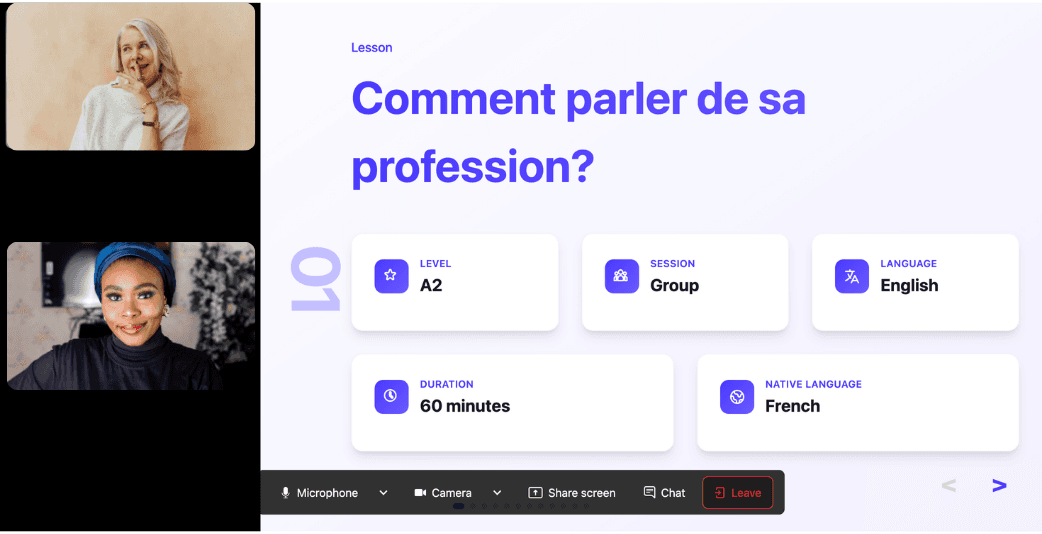
In a 25-minute lesson, Kylian teaches exactly what you need to know about your chosen topic: the nuances that textbooks never explain, key cultural differences between French and your target language, grammar rules, and much more.
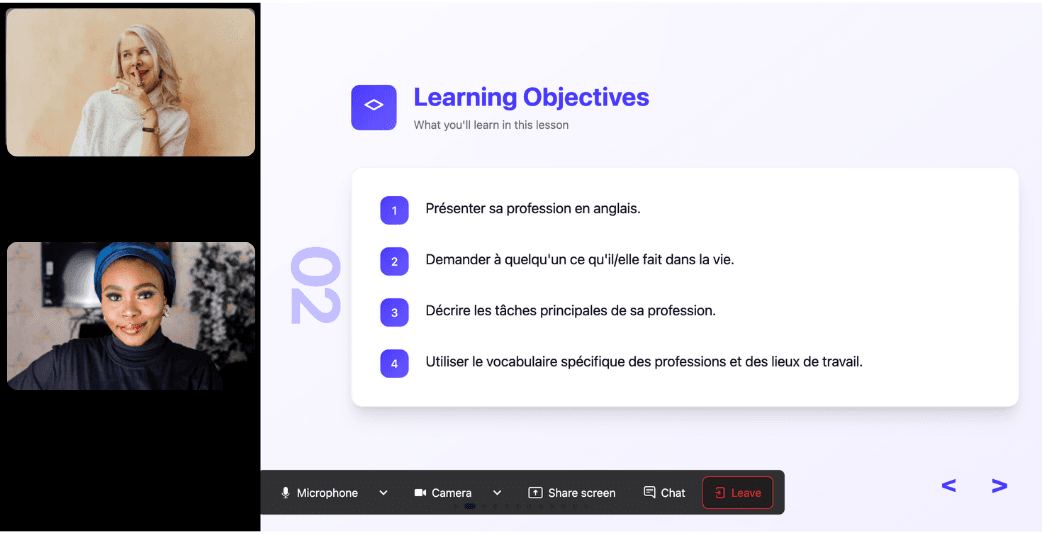
Ever felt frustrated trying to keep up with a native-speaking teacher, or embarrassed to ask for something to be repeated? With Kylian, that problem disappears. It switches intelligently between French and the target language depending on your level, helping you understand every concept at your own pace.
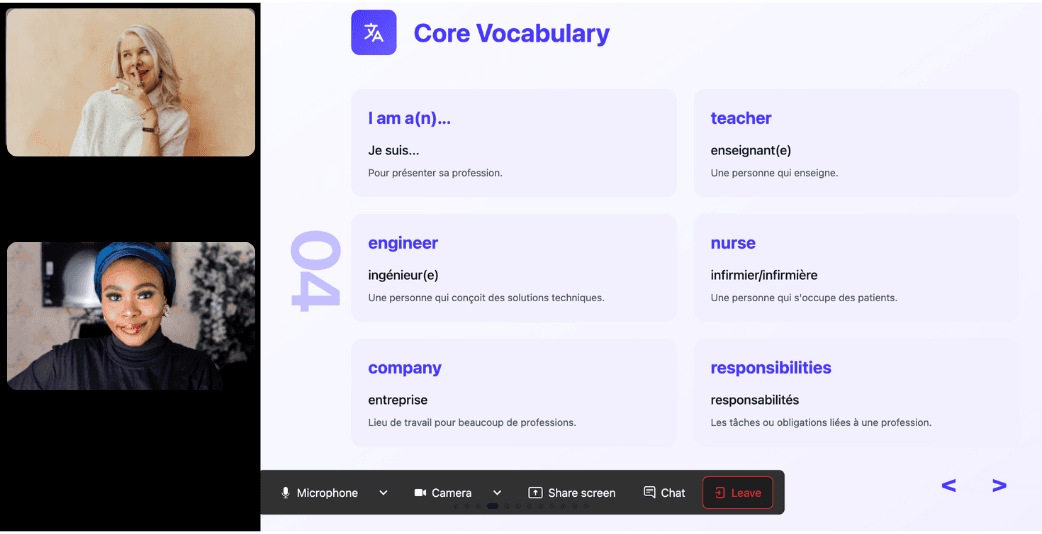
During the lesson, Kylian uses role-plays, real-life examples, and adapts to your learning style. Didn’t understand something? No problem—you can pause Kylian anytime to ask for clarification, without fear of being judged.
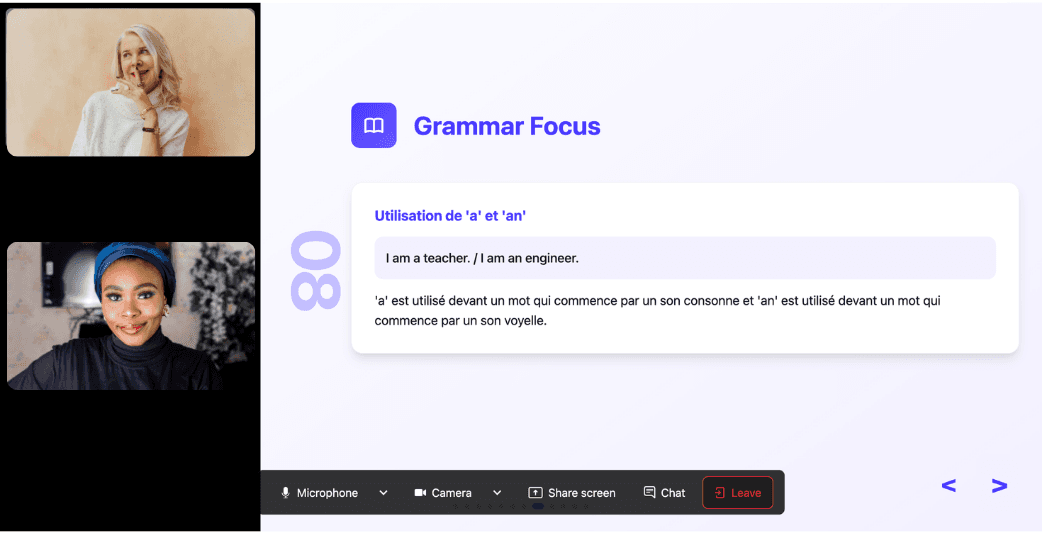
Ask all the questions you want, repeat sections if needed, and customize your learning experience in ways traditional teachers and generic apps simply can’t match.
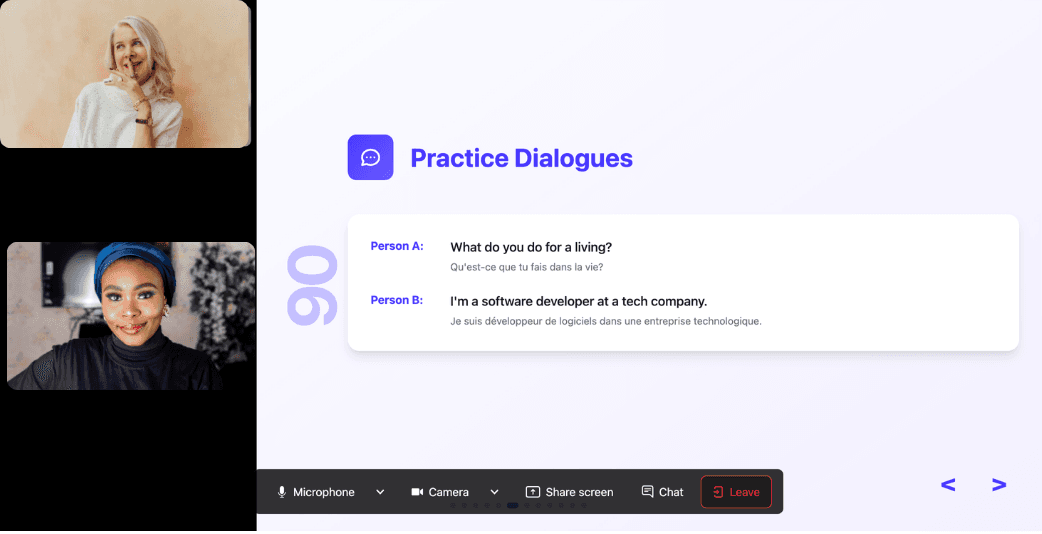
With 24/7 access at a fraction of the cost of private lessons, Kylian removes all the barriers that have kept you from mastering the language you’ve always wanted to learn.