Boost Your Vocabulary with English Adjective Synonyms

Written by
Ernest Bio Bogore

Reviewed by
Ibrahim Litinine
Language acquisition extends far beyond memorizing words and phrases. It demands the ability to deploy these linguistic tools seamlessly in everyday conversation without hesitation. This represents the fundamental distinction between passive vocabulary recognition and active vocabulary implementation.
Contemporary communication has become saturated with predictable, overused terminology that barely registers in our consciousness. Replacing these mundane expressions with vivid alternatives transforms your communication into something more compelling and emotionally resonant.
For writers, a robust English vocabulary enables the development of a distinctive voice and establishes the atmospheric elements of your work. Consider the stark difference between "the weather was bad" and a more nuanced description that creates a specific emotional landscape for readers.
English language learners preparing for standardized tests like IELTS (British English-focused) or TOEFL (American English-focused) gain significant advantages from vocabulary enhancement. Their performance metrics directly correlate with lexical diversity and precision.
While numerous methodologies exist for vocabulary development, mastering synonyms and incorporating them consistently represents one of the most efficient pathways to linguistic sophistication.
Understanding Synonyms: Definition and Importance
A synonym, fundamentally, represents a word or phrase conveying identical or similar meaning to another term. This contrasts with antonyms, which express opposite meanings. The English language contains an extraordinary wealth of synonyms, though utilizing them effectively requires more nuance than simple substitution.
Context remains the critical factor when selecting appropriate synonyms. Certain terms function interchangeably across contexts, while others demand specific situational application. This precision makes reference tools like thesauruses invaluable for identifying suitable alternatives to common terms.
Consider the verbs "commence" and "initiate" as alternatives to "begin." All three convey the same core concept of starting something, yet each carries subtle connotations that might prove more appropriate depending on the formality or domain of communication.
Similarly, "attractive" and "appealing" share a semantic core, but their usage varies considerably depending on whether describing people, ideas, or opportunities. The ability to navigate these distinctions elevates communication from merely functional to genuinely effective.
Organizing Your Synonym Learning Strategy
The most effective approach to synonym acquisition involves categorizing them thematically and maintaining systematic documentation. Rather than attempting to memorize synonyms randomly, create logical groupings based on emotional states, descriptive qualities, or semantic domains.
Digital or physical vocabulary notebooks organized by thematic sections allow for targeted learning and efficient reference. Each entry should include:
- The base word
- Multiple synonyms
- Brief contextual examples
- Notes on usage limitations
- Etymological information (when relevant)
Consider implementing spaced repetition techniques, reviewing newly acquired synonyms at increasing intervals to reinforce retention. Practical application remains the ultimate reinforcement – consciously incorporating new terms into written and spoken communication solidifies their place in your active vocabulary.
Synonyms for Emotional States
Beyond "Happy": Expressing Positive Emotions
"Happy" represents perhaps the most frequently overused emotional descriptor in English. Consider these more precise alternatives:
Cheerful - Exhibiting positive energy and attitude, often describing both individuals and environments that exude brightness and pleasantness.
Delighted - Expressing pronounced pleasure or satisfaction, typically in response to a specific event or circumstance.
Ecstatic - Feeling or demonstrating overwhelming joy or excitement, representing emotional intensity that exceeds standard happiness.
Contented - Experiencing satisfaction with one's current circumstances, possessions, or situation, suggesting a peaceful form of happiness.
Jubilant - Feeling or expressing great happiness, especially because of a success or victory, often accompanied by celebratory behavior.
Blissful - Experiencing perfect happiness or joy, often suggesting a serene or peaceful happiness rather than excited enthusiasm.
Euphoric - Feeling intense excitement and happiness, sometimes artificially induced or exaggerated, beyond typical happiness.
The difference between "I'm happy about the promotion" and "I'm ecstatic about the promotion" communicates substantially different emotional intensities, allowing for more authentic expression.
Beyond "Sad": Nuanced Expressions of Negative Emotions
Similarly, "sad" represents a baseline emotional state with numerous gradations worth exploring:
Melancholy - A pensive sadness, often without obvious cause, suggesting thoughtfulness alongside emotional heaviness.
Despondent - Feeling hopeless and without enthusiasm, indicating a more severe emotional state than simple sadness.
Crestfallen - Visibly disappointed or dejected, typically in response to a specific disappointment.
Forlorn - Appearing sad or abandoned, suggesting loneliness alongside sadness.
Disheartened - Experiencing discouragement or a loss of confidence or enthusiasm, particularly after a setback.
Desolate - Feeling abandoned and hopeless, suggesting an extreme state of sadness often tied to isolation.
Morose - Exhibiting a sullen, gloomy disposition, suggesting an ongoing negative emotional state rather than a temporary response.
When communicating that "She felt sad after not getting the job," replacing "sad" with "crestfallen" or "despondent" provides crucial information about the severity and nature of the emotional response.
Descriptive Quality Synonyms
Elevating "Good" to Precise Excellence
Few words appear more frequently or with less impact than "good," yet countless alternatives exist:
Exemplary - Setting a standard that others should follow, suggesting not just quality but model status.
Superb - Of exceptional quality, suggesting perfection or near-perfection.
Stellar - Outstanding or exceptional, often used to describe performance or achievement.
Impeccable - Without fault or error, perfect, suggesting flawlessness.
Phenomenal - Remarkable or extraordinary, suggesting unusually excellent qualities.
Paramount - Supreme or preeminent, suggesting something of highest importance or quality.
Peerless - Unequaled or unrivaled, suggesting uniqueness in quality.
The sentence "This is a good report" transforms completely when "good" becomes "exemplary" or "stellar," communicating specific quality attributes rather than general approval.
Beyond "Bad": Articulating Different Aspects of Deficiency
Similarly, "bad" represents a generic negative assessment with multiple potential replacements that provide greater specificity:
Subpar - Below an acceptable standard, but without extreme negativity.
Deficient - Lacking some essential element or quality, suggesting incompleteness rather than total failure.
Inadequate - Not sufficient for a particular purpose, suggesting a failure to meet specific requirements.
Abysmal - Extremely bad or of very poor quality, suggesting a profound level of failure.
Mediocre - Of moderate or low quality, neither good nor extremely bad, suggesting disappointment rather than disaster.
Deplorable - Deserving strong condemnation, suggesting moral or ethical failings.
Inferior - Lower in quality or value when compared with something else, suggesting a relative rather than absolute assessment.
Rather than saying "The service was bad," stating "The service was deplorable" or "The service was subpar" communicates specific aspects of the deficiency that provide meaningful feedback.
Appearance and Aesthetic Synonyms
Refining Descriptions of Beauty and Attractiveness
When describing visually appealing subjects, numerous alternatives to "beautiful" exist:
Exquisite - Extremely beautiful and delicate, suggesting refined elegance.
Captivating - Capable of attracting and holding interest, suggesting a compelling quality beyond mere appearance.
Resplendent - Characterized by brilliant or magnificent appearance, suggesting radiance or opulence.
Alluring - Powerfully and mysteriously attractive or fascinating, suggesting a magnetic quality.
Sublime - Inspiring awe or admiration through grandeur or beauty, suggesting transcendence.
Ravishing - Delightful or entrancing, suggesting an overwhelming positive impact on observers.
Splendid - Magnificent or impressive in appearance, suggesting grandeur alongside beauty.
A "beautiful landscape" becomes a "resplendent landscape" or a "sublime landscape," communicating specific aesthetic qualities that evoke different emotional responses.
Expanding Expressions of Unattractiveness
Similarly, the vocabulary for describing unappealing aesthetics extends beyond simple terms like "ugly":
Unsightly - Unpleasant to look at, suggesting visual discomfort rather than extreme unattractiveness.
Grotesque - Distorted to create an unnatural, alienating effect, suggesting deliberate unconventionality.
Unappealing - Not attractive or interesting, suggesting a mild negative reaction rather than revulsion.
Hideous - Extremely ugly or revolting, suggesting an intense negative visual impact.
Disheveled - Untidy or disorganized in appearance, suggesting a lack of care rather than inherent unattractiveness.
Ghastly - Causing great horror or fear, unpleasant to look at, suggesting an emotional response beyond mere visual assessment.
Repulsive - Causing strong dislike or disgust, suggesting an active negative reaction rather than passive distaste.
The difference between "an ugly building" and "a grotesque building" or "an unsightly building" communicates substantially different architectural assessments.
Intensity and Magnitude Synonyms
Beyond "Very": Expressing Degrees of Intensity
The overused intensifier "very" represents perhaps the most substitutable word in English:
Exceedingly - To an extremely large degree, suggesting surpassing expectations.
Tremendously - To a very great extent, suggesting impressive scale or impact.
Profoundly - Deeply or extremely, suggesting depth rather than just magnitude.
Remarkably - In a way that deserves attention because unusual or special, suggesting noteworthiness.
Immensely - To an extremely large extent, suggesting overwhelming scale.
Extraordinarily - To an exceptional degree, suggesting deviation from normal patterns.
Vastly - To a very great extent, suggesting spatial or conceptual expansiveness.
Rather than "very important," consider "profoundly important" or "crucially important" to communicate specific aspects of significance.
Communicating Scale and Proportion
Similarly, precise vocabulary exists for discussing matters of size and quantity:
Colossal - Extremely large or great, suggesting impressive physical scale.
Minuscule - Extremely small, suggesting near-invisibility or insignificance.
Substantial - Considerable in quantity, suggesting significance without extremity.
Marginal - Small or minimal, suggesting borderline significance.
Abundant - Existing in large quantities, suggesting plentiful availability.
Scarce - Insufficient for the demand, suggesting rarity or limited availability.
Monumental - Great in importance, extent, or size, suggesting historical significance alongside physical scale.
A "big problem" transforms into a "monumental challenge" or a "substantial obstacle," immediately communicating specific aspects of scale and importance.
Intellectual and Cognitive Synonyms
Expressing Intelligence and Mental Capacity
When discussing intellectual capabilities, numerous descriptors exist beyond "smart":
Astute - Having or showing an ability to notice and understand things clearly, suggesting perceptiveness.
Erudite - Having or showing great knowledge or learning, suggesting scholarly achievement.
Perceptive - Having or showing sensitive insight, suggesting emotional intelligence alongside analytical capability.
Sagacious - Having or showing keen discernment, sound judgment, and farsightedness, suggesting wisdom.
Ingenious - Showing inventiveness and skill, suggesting creative problem-solving abilities.
Analytical - Using or skilled in using analysis, suggesting methodical thinking processes.
Discerning - Showing good judgment and understanding, suggesting refined taste or perception.
Rather than describing someone as "smart," identifying them as "astute" or "erudite" communicates specific intellectual qualities and strengths.
Describing Learning Processes and Knowledge Acquisition
Similarly, precise vocabulary exists for discussing educational contexts:
Comprehensive - Including or dealing with all or nearly all aspects of something, suggesting thoroughness.
Superficial - Appearing to be true or real only until examined more closely, suggesting lack of depth.
Meticulous - Showing great attention to detail, suggesting careful examination.
Cursory - Done rapidly and not thoroughly, suggesting insufficient attention.
Exhaustive - Including all possible elements or aspects, suggesting completeness.
Perfunctory - Carried out without real interest, feeling, or effort, suggesting minimal engagement.
Rigorous - Extremely thorough and careful, suggesting disciplined methodology.
A "good understanding" becomes a "comprehensive grasp" or a "meticulous analysis," immediately communicating the nature and quality of cognitive processing.
Practical Applications of Synonym Knowledge
Enhancing Professional Communication
In professional contexts, precise vocabulary creates substantial advantages:
- More accurate performance evaluations through specific behavioral descriptions
- Stronger persuasive presentations through emotionally calibrated language
- More effective feedback through nuanced positive and constructive commentary
- Enhanced credibility through demonstration of domain expertise
- More impactful written communication through reduced repetition
For example, describing a colleague's work as "competent" versus "exemplary" or "adequate" communicates vastly different performance assessments that influence promotion and compensation decisions.
Elevating Creative Writing Quality
For fiction and creative non-fiction writers, synonym mastery transforms storytelling:
- More vivid character descriptions through precise emotional and physical details
- Stronger atmospheric elements through environmental specificity
- More authentic dialogue through character-specific vocabulary choices
- Reduced repetition through lexical variety
- More powerful emotional impacts through calibrated intensity
The difference between "The old house was scary" and "The decrepit mansion was foreboding" immediately establishes different genre expectations and emotional landscapes for readers.
Improving Academic Writing Precision
In academic contexts, synonym knowledge enables:
- More accurate theoretical discussions through precise terminology
- Stronger argumentative positioning through nuanced claims
- More effective literature reviews through varied descriptive language
- Enhanced methodological descriptions through precise procedural language
- More convincing analysis through calibrated assertiveness
Rather than describing research results as "important," characterizing them as "foundational," "incremental," or "paradigm-shifting" communicates specific contributions to disciplinary knowledge.
Effective Strategies for Synonym Acquisition
Immersive Learning Approaches
While traditional memorization has value, environmental exposure proves more effective for natural acquisition:
- Reading widely across different genres and domains
- Listening to podcasts and audiobooks in varied subject areas
- Watching documentaries and lectures with sophisticated vocabulary
- Engaging with native speakers across different professional contexts
- Following thought leaders in your field who demonstrate linguistic sophistication
Each approach provides contextual examples of appropriate synonym usage that memorization alone cannot provide.
Active Implementation Techniques
Converting passive recognition into active usage requires deliberate practice:
- Daily selection of 3-5 target synonyms for conscious implementation
- Journaling using newly acquired vocabulary
- Conversation partners who provide usage feedback
- Regular writing exercises focused on lexical variety
- Recording and analyzing your speech patterns
The transformation from recognition to implementation typically requires 10-12 deliberate usage instances before a word enters your active vocabulary.
Digital Tools for Synonym Enhancement
Numerous technological resources facilitate vocabulary expansion:
- Etymology dictionaries that explain word origins and relationships
- Contextual thesauruses that provide usage examples
- Spaced repetition apps for systematic review
- Writing analysis tools that identify repetition
- Vocabulary tracking systems that document acquisition
Technology enables more systematic and data-driven approaches to vocabulary development than traditional methods alone.
Learn Any Language with Kylian AI
Private language lessons are expensive. Paying between 15 and 50 euros per lesson isn’t realistic for most people—especially when dozens of sessions are needed to see real progress.
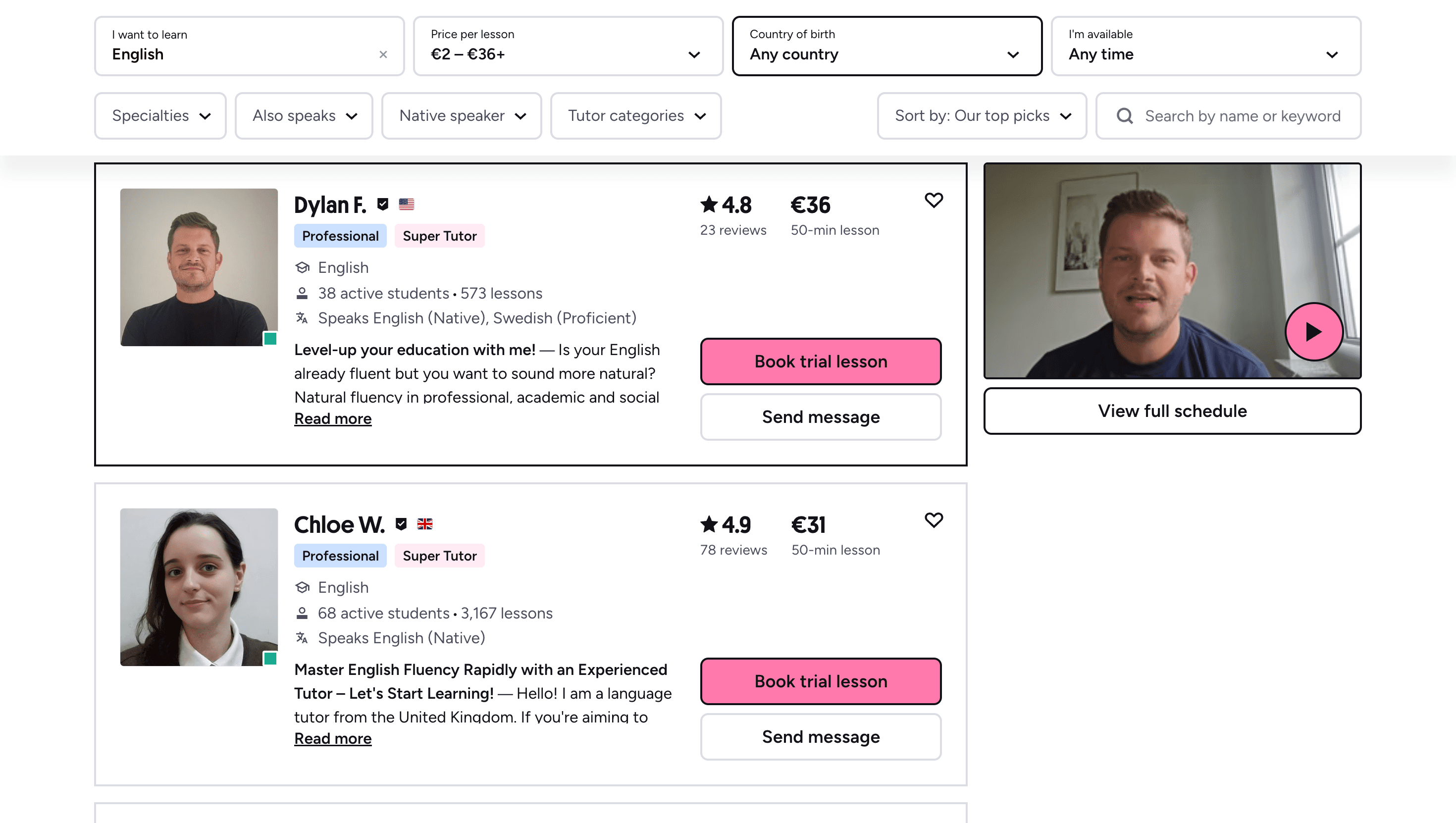
Many learners give up on language learning due to these high costs, missing out on valuable professional and personal opportunities.
That’s why we created Kylian: to make language learning accessible to everyone and help people master a foreign language without breaking the bank.
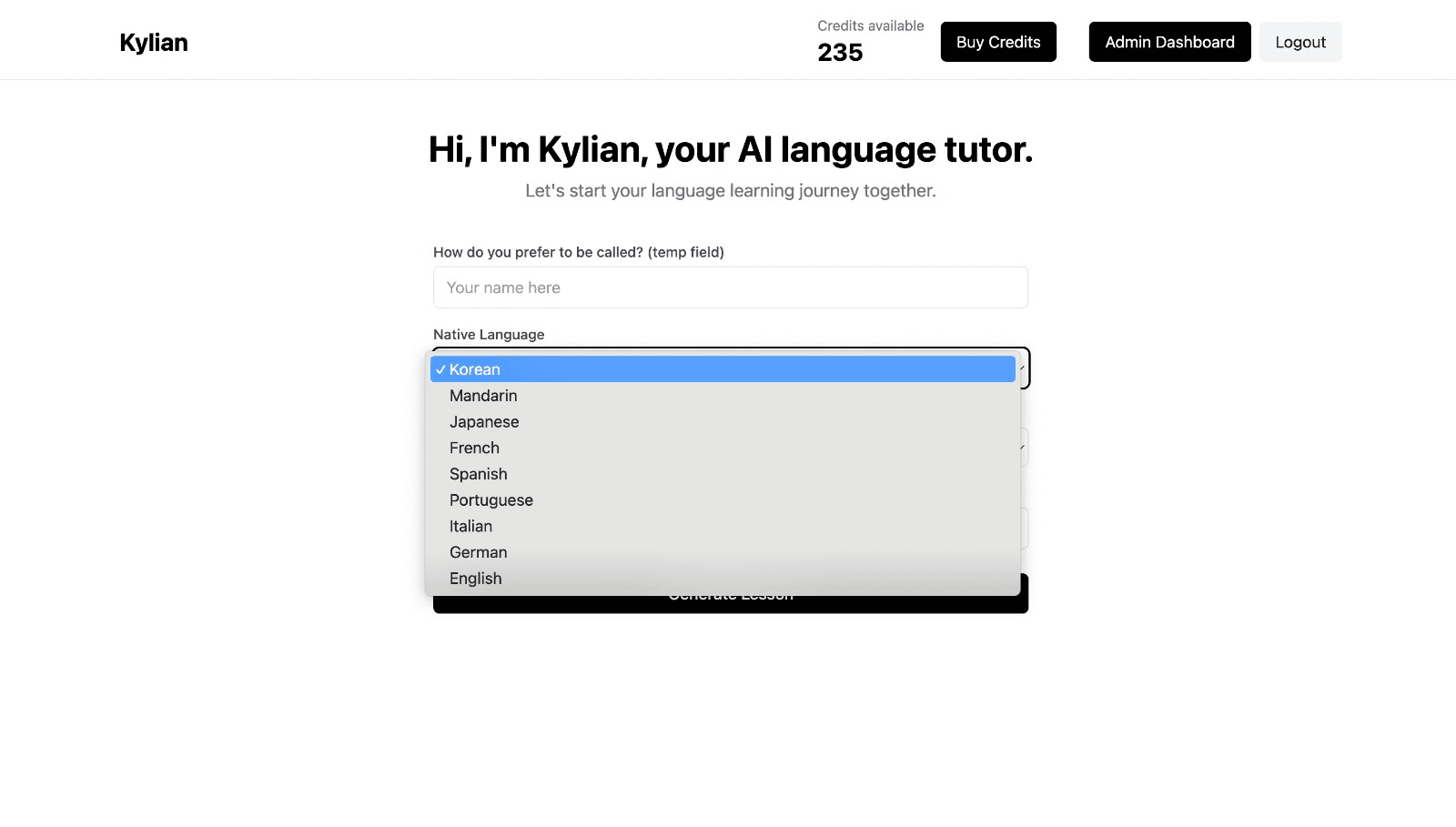
To get started, just tell Kylian which language you want to learn and what your native language is
Tired of teachers who don’t understand your specific struggles as a French speaker? Kylian’s advantage lies in its ability to teach any language using your native tongue as the foundation.
Unlike generic apps that offer the same content to everyone, Kylian explains concepts in your native language (French) and switches to the target language when necessary—perfectly adapting to your level and needs.
This personalization removes the frustration and confusion that are so common in traditional language learning.
Choose a specific topic you want to learn
Frustrated by language lessons that never cover exactly what you need? Kylian can teach you any aspect of a language—from pronunciation to advanced grammar—by focusing on your specific goals.
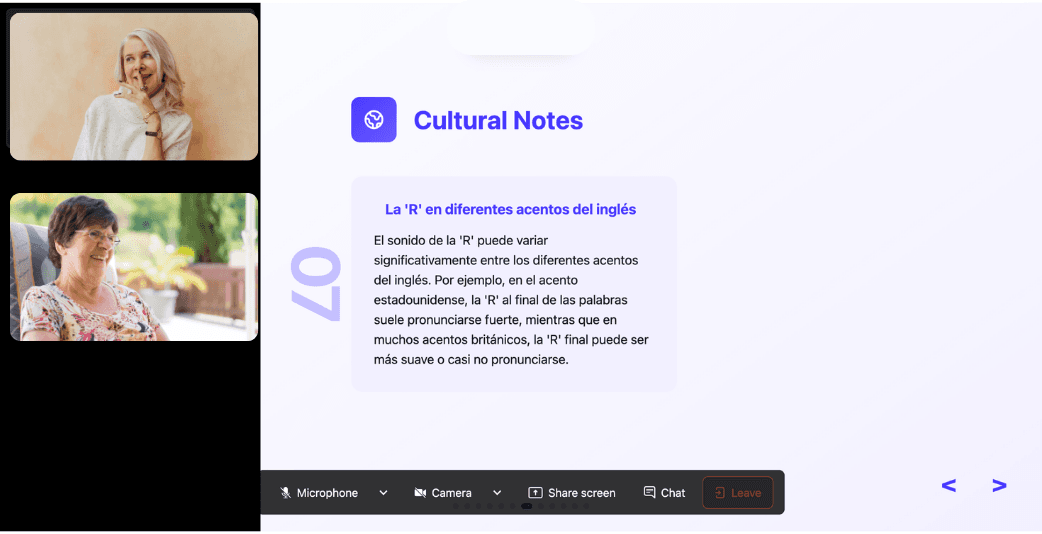
Avoid vague requests like “How can I improve my accent?” and be precise: “How do I pronounce the R like a native English speaker?” or “How do I conjugate the verb ‘to be’ in the present tense?”
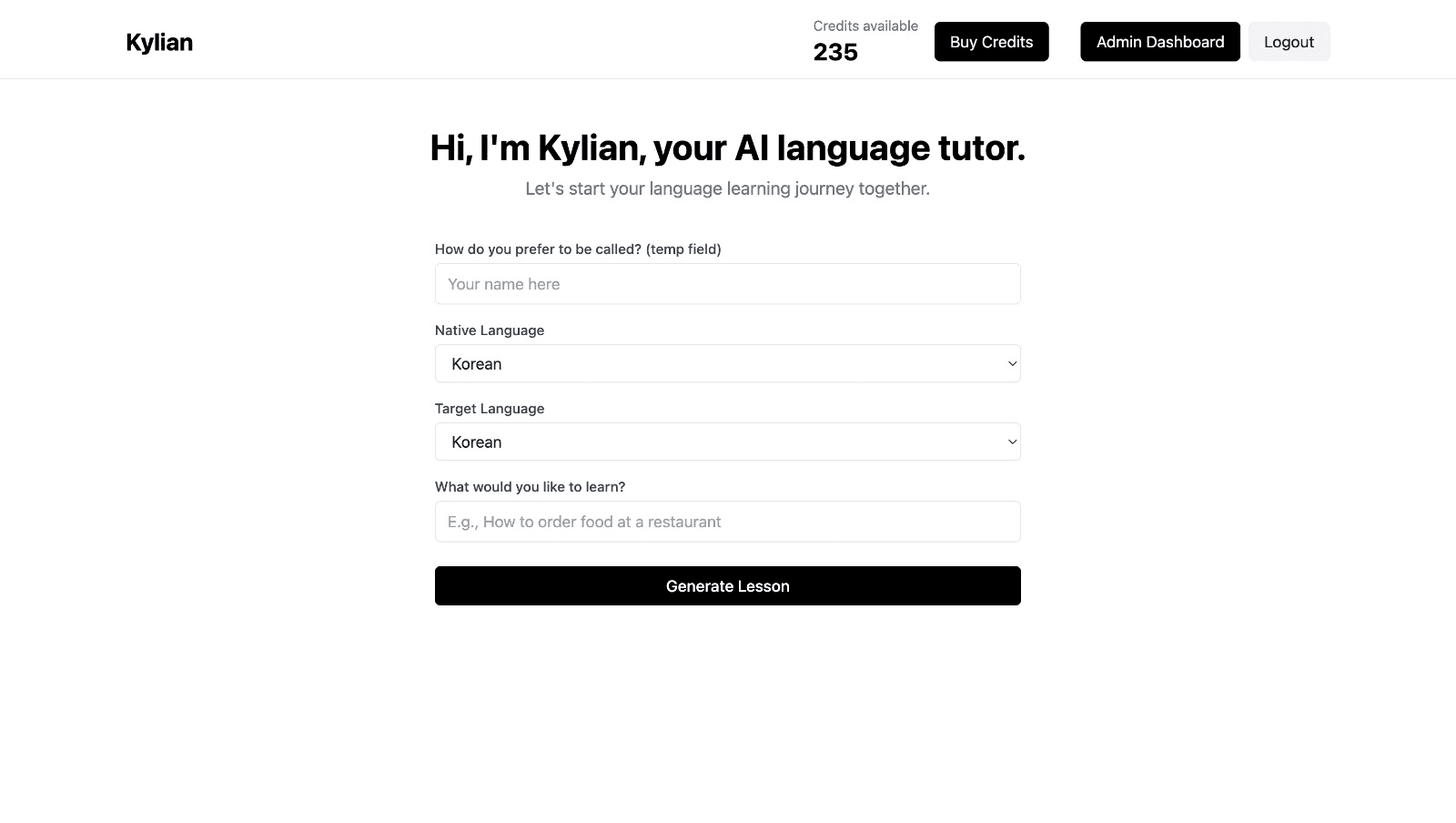
With Kylian, you’ll never again pay for irrelevant content or feel embarrassed asking “too basic” questions to a teacher. Your learning plan is entirely personalized.
Once you’ve chosen your topic, just hit the “Generate a Lesson” button, and within seconds, you’ll get a lesson designed exclusively for you.
Join the room to begin your lesson
The session feels like a one-on-one language class with a human tutor—but without the high price or time constraints.
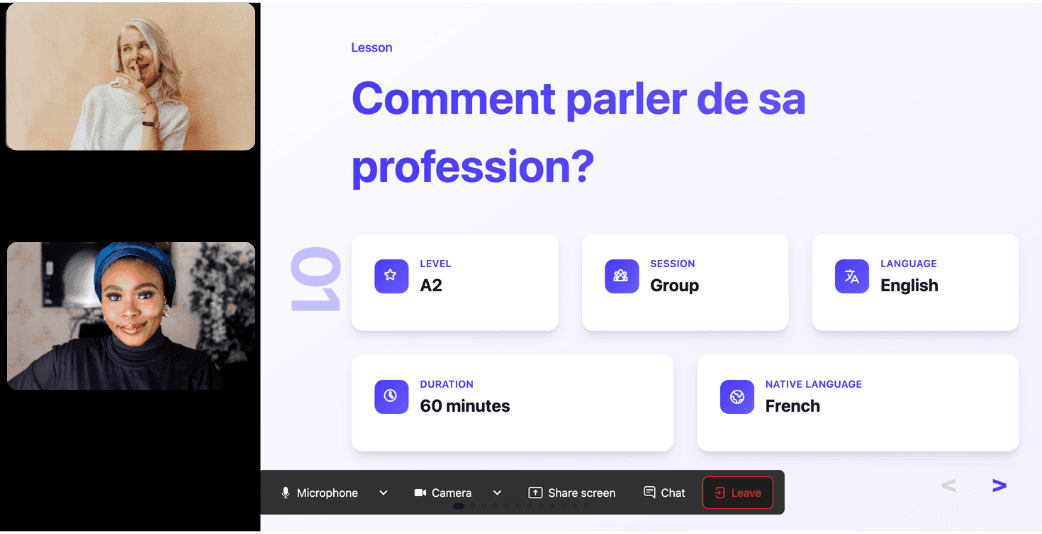
In a 25-minute lesson, Kylian teaches exactly what you need to know about your chosen topic: the nuances that textbooks never explain, key cultural differences between French and your target language, grammar rules, and much more.

Ever felt frustrated trying to keep up with a native-speaking teacher, or embarrassed to ask for something to be repeated? With Kylian, that problem disappears. It switches intelligently between French and the target language depending on your level, helping you understand every concept at your own pace.
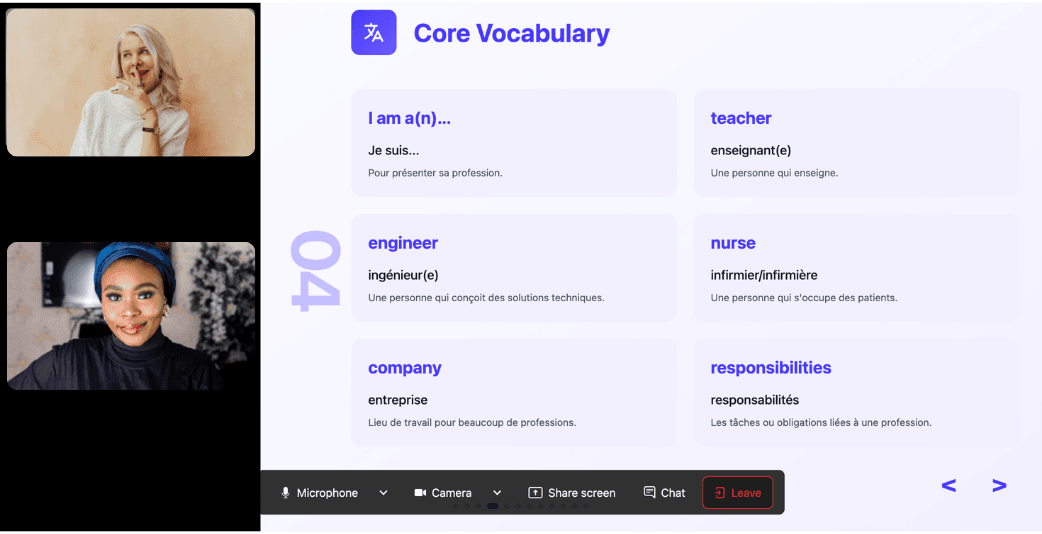
During the lesson, Kylian uses role-plays, real-life examples, and adapts to your learning style. Didn’t understand something? No problem—you can pause Kylian anytime to ask for clarification, without fear of being judged.
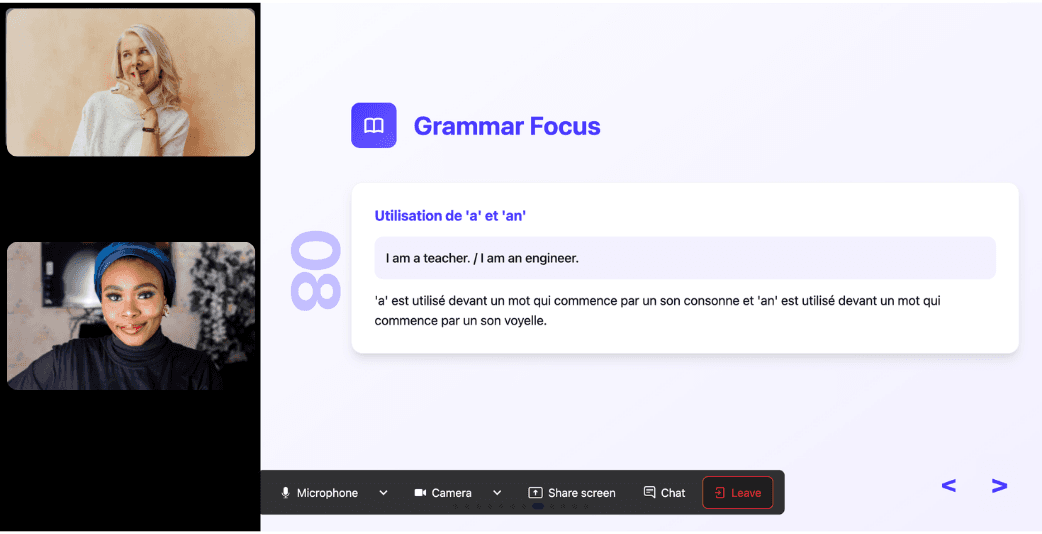
Ask all the questions you want, repeat sections if needed, and customize your learning experience in ways traditional teachers and generic apps simply can’t match.
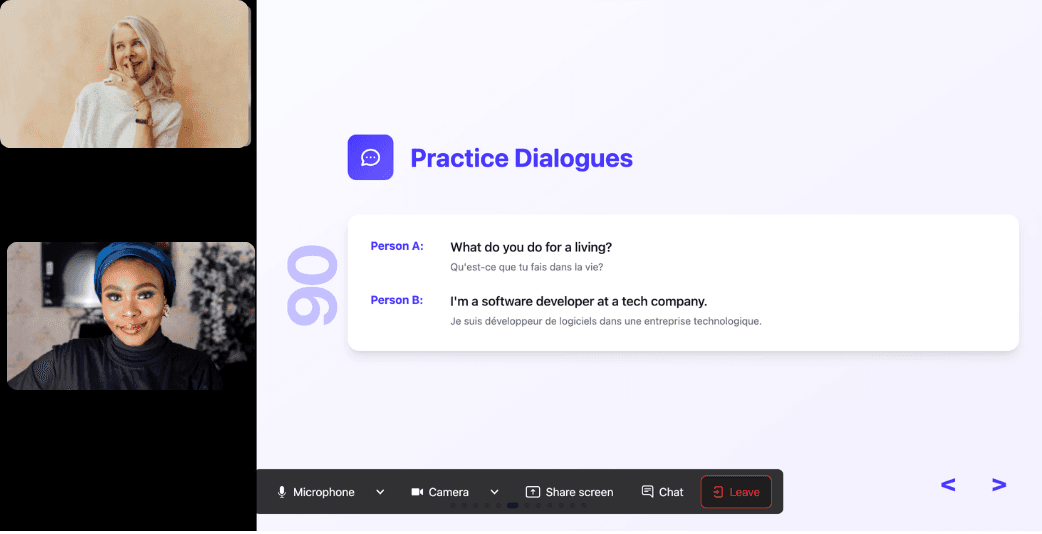
With 24/7 access at a fraction of the cost of private lessons, Kylian removes all the barriers that have kept you from mastering the language you’ve always wanted to learn.
Similar Content You Might Want To Read

Diagnoses or Diagnosis: Which Form is Correct in English?
Language precision matters, particularly in specialized fields like medicine, where the distinction between singular and plural forms can significantly impact communication clarity. The terms "diagnosis" and "diagnoses" represent a prime example of this linguistic specificity. Their correct usage differs contextually, and misapplying them can lead to miscommunication in critical situations.

How to Learn Swedish: 10 Strategic Steps to Language Fluency
Swedish stands as a gateway to Scandinavian culture, opening doors to unprecedented opportunities for both personal and professional growth. As the most widely spoken North Germanic language, Swedish serves as a linguistic bridge connecting over 10 million speakers across Sweden and parts of Finland. What makes Swedish particularly appealing for English speakers is its Germanic roots—sharing vocabulary patterns, grammatical structures, and cultural references that create a surprisingly accessible learning path. Yet despite these advantages, mastering Swedish requires strategic approach and consistent practice. This comprehensive guide outlines ten evidence-based strategies that transform Swedish language acquisition from intimidating to achievable. Whether your motivation stems from career advancement, cultural immersion, or intellectual curiosity, these methods will establish a solid foundation for Swedish language proficiency.

How to Learn English by Yourself: Your Path to Fluency
English stands as the most widely studied second language globally. With an abundance of learning materials, self-proclaimed language hacks, and supportive online communities at your disposal, the path to English proficiency has never been more accessible. But for those needing to learn English efficiently, what approach yields the most effective results? This guide offers a methodical approach to mastering English independently. We'll examine proven techniques for accelerating your progress, explain the science behind their effectiveness, and identify the essential resources for achieving fluency.

How to Learn French Fast: A Step-by-Step Guide for Beginners
French—often called the language of love—carries an undeniable elegance, particularly in its melodic sounds. However, its grammatical complexities, inconsistent spelling patterns, and numerous rule exceptions can intimidate beginners. If you've ever dreamed of conversing with locals in Paris or working for a French organization, you might wonder if achieving proficiency requires years of dedication. The reality? With strategic learning approaches and consistent practice, you can reach basic conversational proficiency in mere months. This guide examines evidence-based methods to accelerate your French learning journey, with actionable steps to implement today. Let's begin!

15 Best Tips to Start Learning Japanese
Japanese is a fascinating language spoken by over 128 million people worldwide. While primarily the national language of Japan, Japanese speakers can also be found in communities across Korea, the United States, and Brazil. If you're considering learning Japanese, you're embarking on a rewarding journey that opens doors to a rich culture and unique worldview. Many prospective learners ask: "Is Japanese difficult to learn?" While it presents distinct challenges compared to European languages, with dedication and the right approach, anyone can make meaningful progress. This guide provides 13 actionable strategies to help absolute beginners start their Japanese language journey effectively.

English Prepositions: Types, Usage & Common Mistakes
Mastering English prepositions is essential for fluent communication, yet these small words often cause significant confusion for language learners. Why? Because prepositions form the connective tissue of English sentences, showing relationships between words in ways that don't always follow predictable patterns. This comprehensive guide will help you understand, learn, and correctly use the wide variety of English prepositions.
